Exploring Old Town Dubrovnik Inside the City Walls
Old Town Dubrovnik was one of the highlights of my visit to Croatia. Before exploring the streets inside the walls, I completed the full walk around the Dubrovnik City Walls. That gave me an overhead look at the red rooftops, church towers and narrow streets that I would later explore at ground level.
I was still recovering from a bad cold, so I did not try to see everything in one long outing. Instead, I returned to Old Town several times, including during the day and after dark. I was staying at the Hilton Imperial Dubrovnik, which made it easy to walk back through Pile Gate whenever I wanted.
This visit also came before I became efficient at planning sightseeing routes. I still saw many of Old Town’s best-known landmarks, but I did not organize my time well enough to see everything. Looking back, there are several important places I would add to a future visit.
There is no admission charge to enter Old Town Dubrovnik, although the City Walls, museums and some individual attractions require tickets. Visitors can enter through several gates, with Pile Gate and Ploče Gate serving as the two best-known entrances.
Table of Contents
- Entering Old Town Dubrovnik Through Pile Gate
- Onofrio’s Fountain and the Church of St. Saviour
- Walking Along Stradun and Exploring the Narrow Streets
- Prijeko Street and the Church of St. Nicholas
- Luža Square and Its Major Landmarks
- The City Bell Tower and Sponza Palace
- The Church of St. Blaise
- Orlando’s Column
- Rector’s Palace and Dubrovnik Cathedral
- The Marin Držić Statue
- Dubrovnik’s Old Port and Ploče Gate
- Exploring Old Town Dubrovnik After Dark
- Dinner Inside Old Town Dubrovnik
- Places I Missed in Old Town Dubrovnik
- Practical Tips for Visiting Old Town Dubrovnik
- Old Town Dubrovnik Walking Tours
- Is Old Town Dubrovnik Worth Visiting?
- Related Content
Disclaimer: Buzzin’ Around the World strives to provide accurate and up-to-date information based on our research at the time of publication. We respect all applicable laws and fair use principles. If you believe any information is incorrect or violates regulations, please contact us at buzzinaroundtheworld@gmail.com.
Affiliate Links and Reviews: We use affiliate links to generate income and may receive a commission at no additional cost to you when you use our links. We strive for honest and transparent reviews, even for products which we receive compensation.
Content Creation: Our content is based on our own travel experiences. All photos are our own unless otherwise stated. We sometimes utilize AI tools to assist with tasks like generating titles, summarizing content, and improving organization.
For more information: For more information, please click HERE to visit our privacy policy page. We can be reached at buzzinaroundtheworld@gmail.com.
Entering Old Town Dubrovnik Through Pile Gate
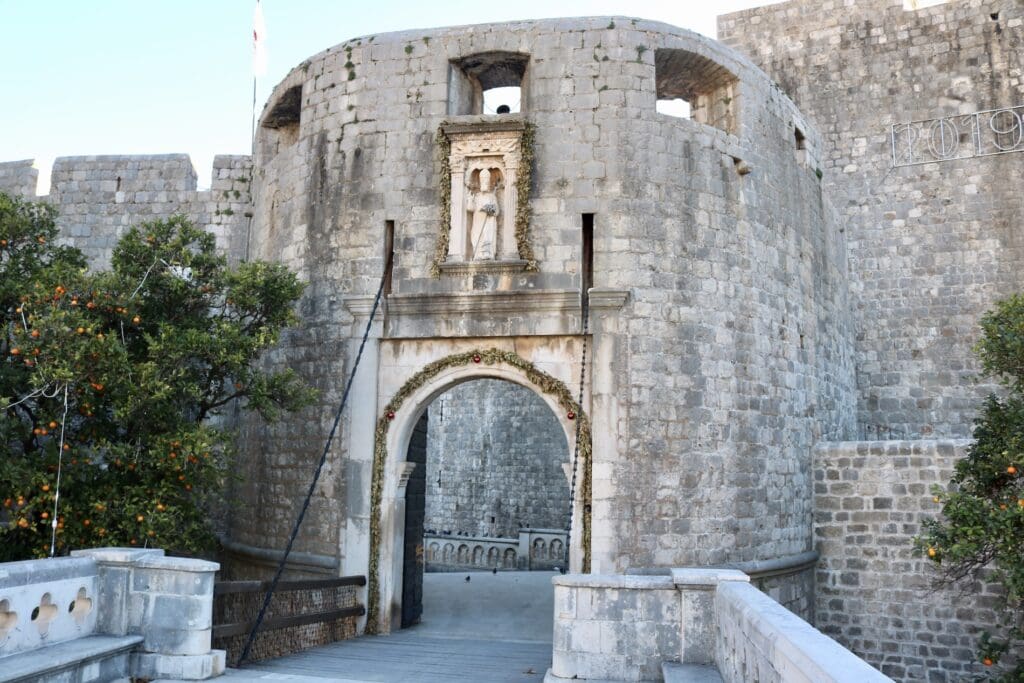
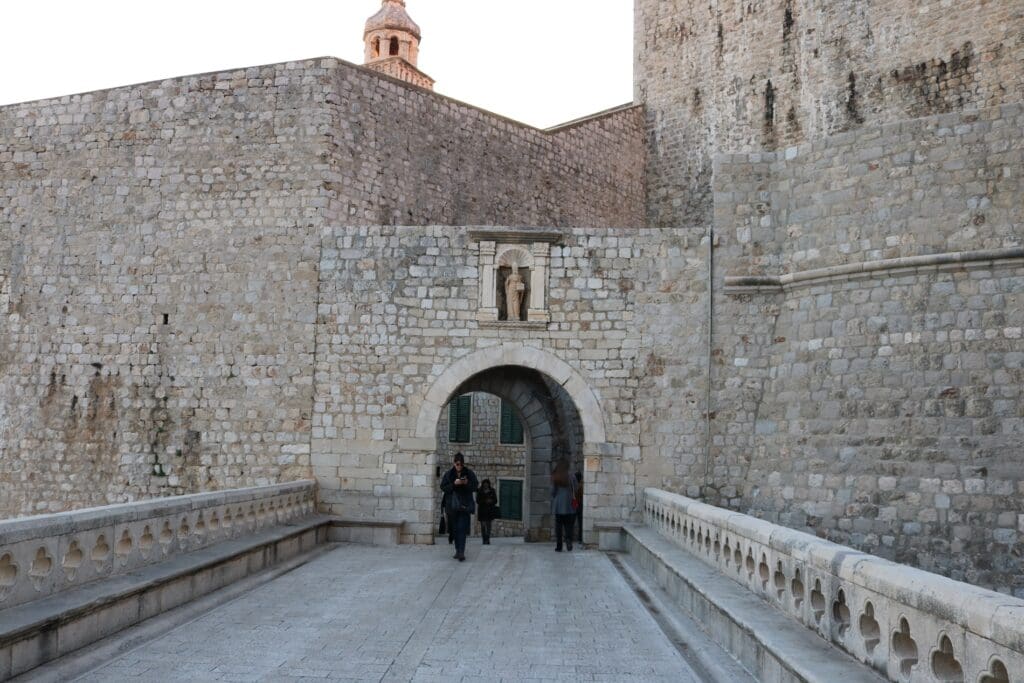
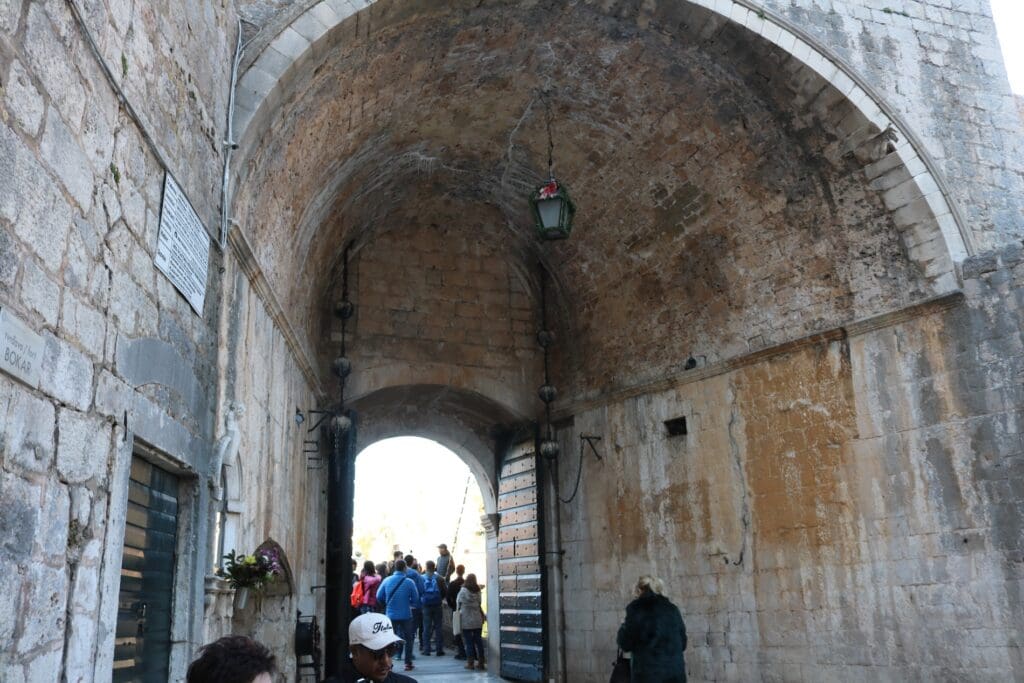
I usually entered Old Town through Pile Gate, the western entrance closest to my hotel. A stone bridge leads toward the outer gate before the route turns and passes through a fortified interior passage. Walking through the gate immediately made Old Town feel separate from the modern city outside the walls.
This was one of my first experiences visiting a true walled city. I had already been to Old Montreal and Gamla Stan in Stockholm, but Dubrovnik felt different. Once I walked through Pile Gate, I was completely surrounded by stone buildings, narrow streets and the city walls. It felt less like visiting a historic neighborhood and more like entering an entire old city.
From the area outside Pile Gate, I could also look toward Lovrijenac Fortress, which rises from a rocky outcrop beyond the western wall. I had already seen it clearly while walking the City Walls earlier in the day.
Onofrio’s Fountain and the Church of St. Saviour
The first major landmark I reached after entering through Pile Gate was Onofrio’s Large Fountain. The rounded stone fountain was constructed as part of Dubrovnik’s 15th-century water-supply system and remains one of the most recognizable meeting points at the western end of Stradun. Water still flows from the carved faces surrounding the fountain, although I did not drink from it during my visit.
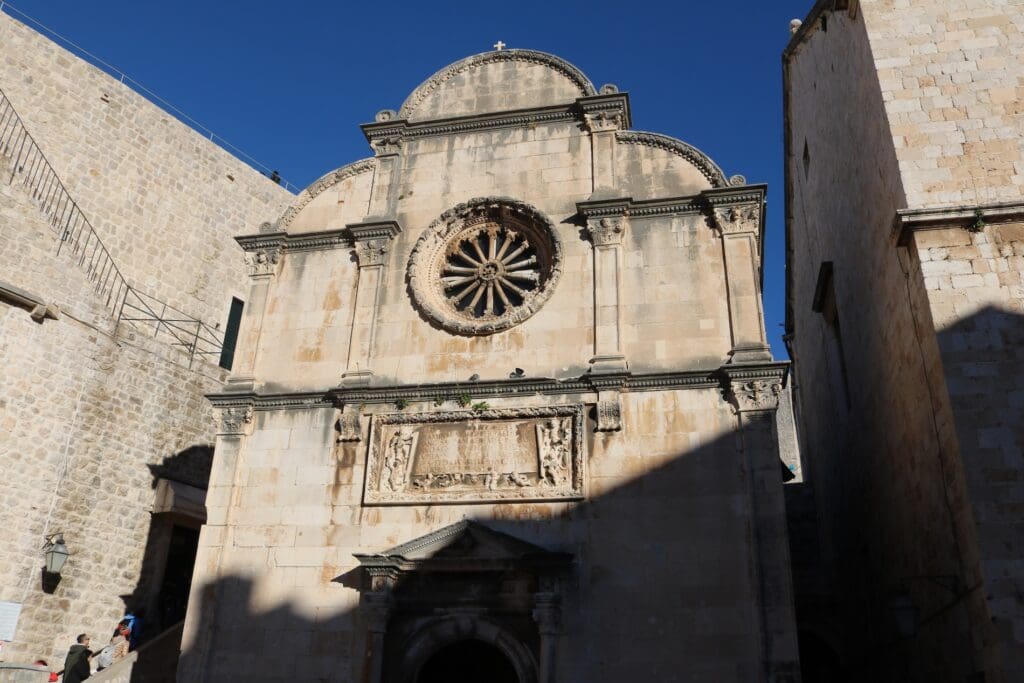
Beside the fountain is the small Church of St. Saviour. The church was built following an earthquake in 1520 and was one of the buildings that survived Dubrovnik’s much more destructive 1667 earthquake. Its decorative stone façade and circular window are easy to overlook beside the much larger Franciscan complex.
The entrance to the Franciscan Monastery is also nearby. Its large complex extends along this western end of Stradun, while its bell tower rises above the surrounding rooftops.
Walking Along Stradun and Exploring the Narrow Streets
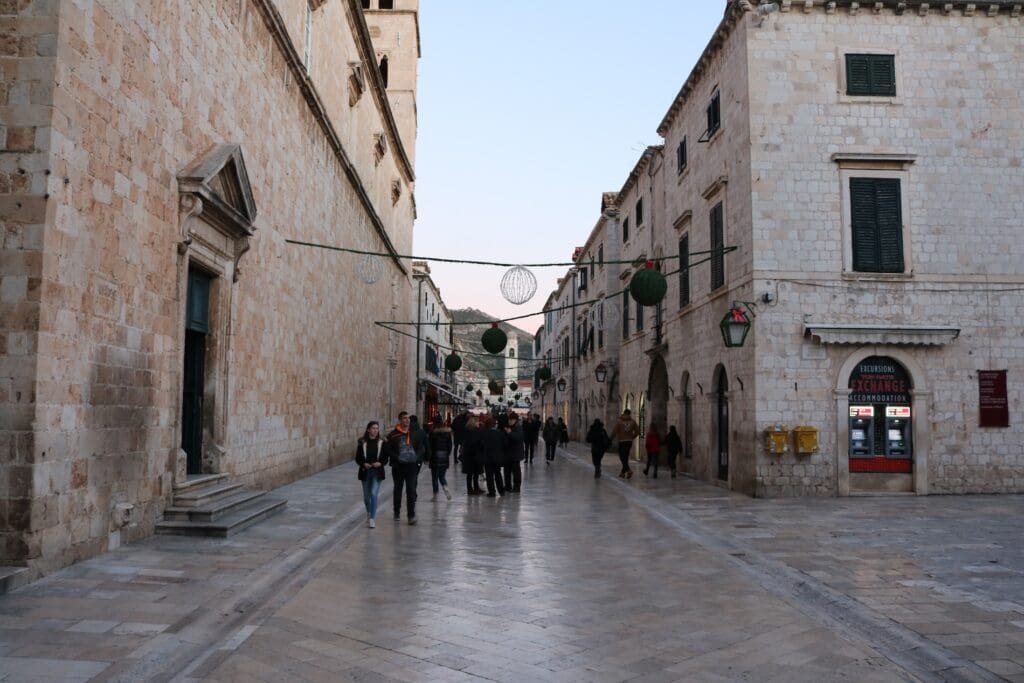
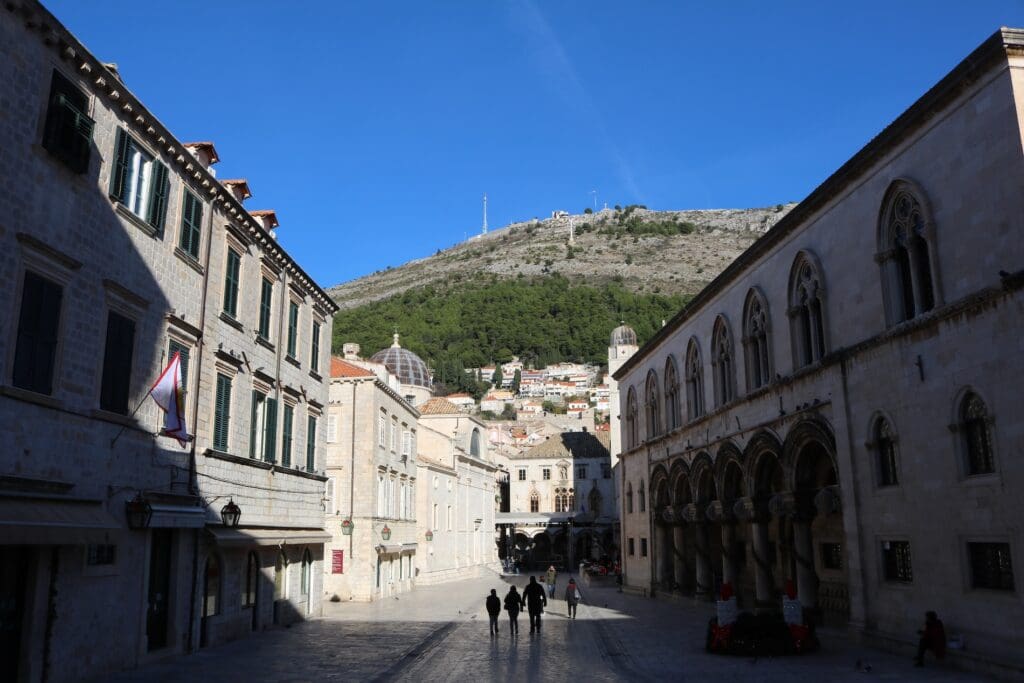
From Onofrio’s Fountain, I continued onto Stradun, the broad limestone street that runs through the center of Old Town. Historic buildings, restaurants and shops line both sides, while narrow streets and stairways lead away from the main route.
Stradun and the side streets made the strongest impression on me. Some of the narrow passages felt almost hidden between the stone buildings. I wandered without following a planned route and became turned around several times. Because the entire area is enclosed by the walls, I was never truly lost, but I often came out of a side street somewhere other than where I expected.
Dubrovnik is closely associated with Game of Thrones, and I saw themed shops, tours and references throughout Old Town. I have never watched an episode and am not a fan of the series, so none of that added anything to my visit. I was much more interested in the city walls, historic buildings and narrow streets.
Prijeko Street and the Church of St. Nicholas
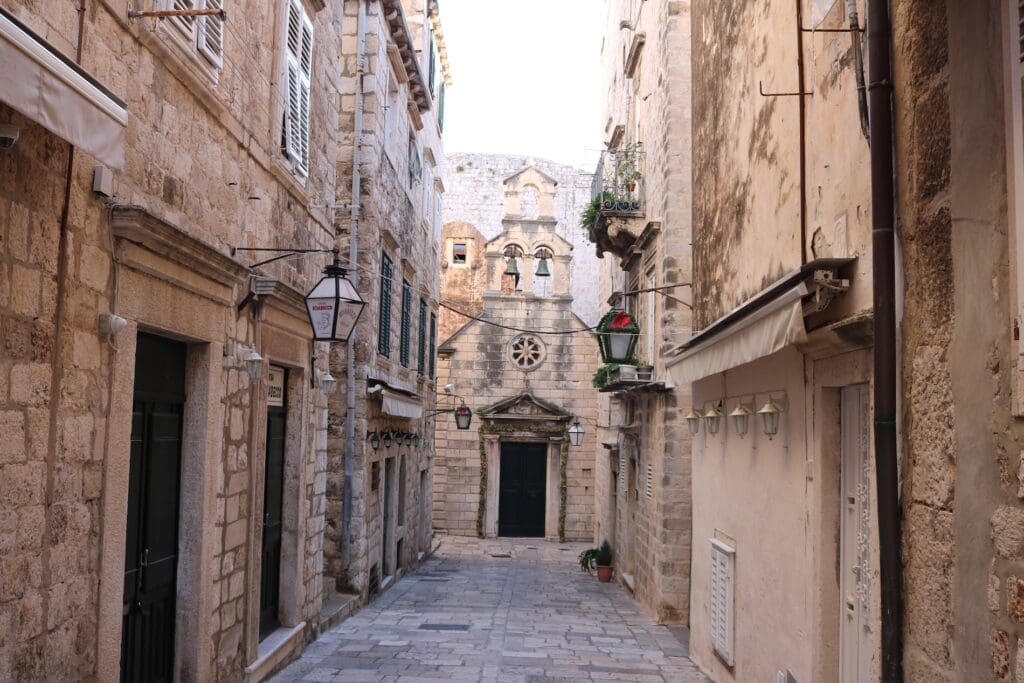
One of the streets running parallel to Stradun is Prijeko, a narrow route known today for its restaurants and historic stone buildings. At its eastern end, I photographed the Church of St. Nicholas. The church has much older origins, although the façade visible today was added during later rebuilding.
The small stone church and the quieter section of Prijeko provided a noticeable change from the wider and busier Stradun.
Luža Square and Its Major Landmarks
At the eastern end of Stradun, several of Dubrovnik’s most important landmarks are grouped closely together around Luža Square.
The City Bell Tower and Sponza Palace
The City Bell Tower rises above Luža Square and can be seen from several parts of Old Town. The clock tower was originally constructed in the 15th century, although the structure visible today was rebuilt in the early 20th century after the earlier tower became unstable. Its bell continues to mark the hours above the square.
Beside the tower is Sponza Palace, recognizable by its arched ground-level gallery and Gothic-Renaissance details. I saw its exterior while walking through the square.
The Church of St. Blaise
Across the square is the Church of St. Blaise, dedicated to Dubrovnik’s patron saint. I went inside and, because no one else was there, had time to look around without feeling rushed. The quiet interior was a sharp contrast to the activity around Stradun.
The church’s Baroque interior includes a richly decorated altar and a gilded statue of St. Blaise holding a model of Dubrovnik. Christmas trees and seasonal decorations were still displayed during my winter visit.
Orlando’s Column
Standing in front of the Church of St. Blaise is Orlando’s Column, which depicts a medieval knight holding a sword. Created under a contract dating to 1418, the column became an important symbol of the Republic of Dubrovnik.
Rector’s Palace and Dubrovnik Cathedral
Continuing beyond Luža Square, I walked past the arched exterior of Rector’s Palace several times. During the Republic of Dubrovnik, the building served as the government’s administrative center and the residence of the elected rector. Today it houses the Cultural History Museum.
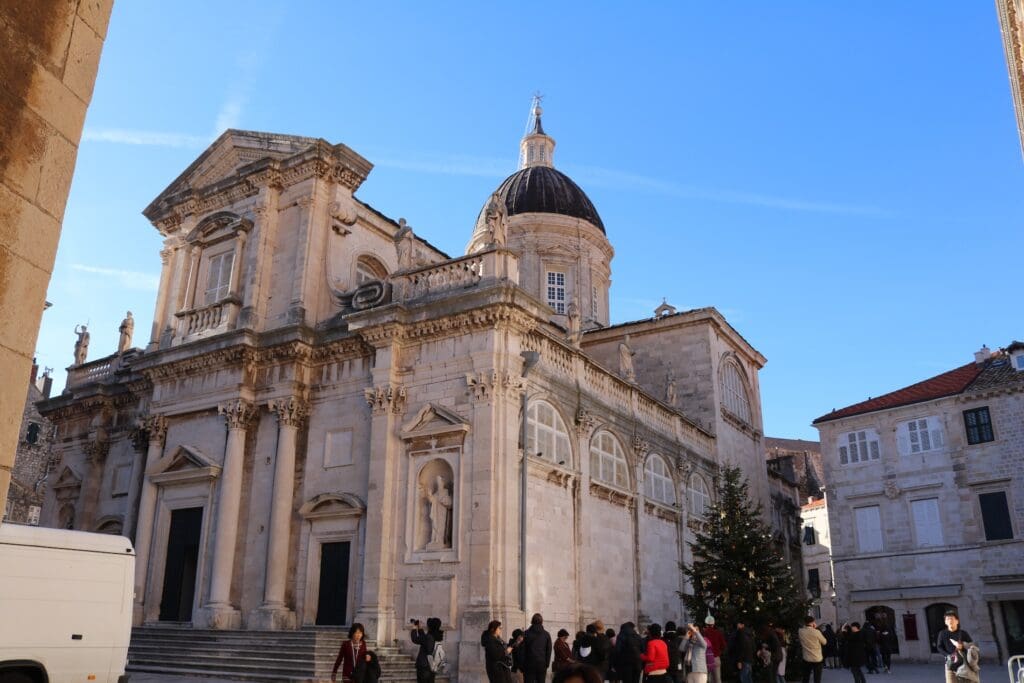
Near the palace is Dubrovnik Cathedral, formally dedicated to the Assumption of the Virgin Mary. The current Baroque cathedral was constructed after the previous building was destroyed in the earthquake of 1667. I could see its large dome from the surrounding streets and from the City Walls, where it stood out above the rooftops.
The Marin Držić Statue
Near Rector’s Palace is a seated statue of Marin Držić, one of Croatia’s best-known Renaissance playwrights. The statue stands between the Marin Držić Theatre and Rector’s Palace.
Dubrovnik’s Old Port and Ploče Gate
One of the most picturesque parts of Old Town was Dubrovnik’s Old Port. The sheltered harbor reflects Dubrovnik’s long maritime history and contains small boats surrounded by the walls and historic buildings. St. John’s Fortress guards the entrance on the southeastern side of the harbor.
From the port area, I continued toward Ploče Gate, the eastern entrance to Old Town. The gate complex sits beside the Dominican Monastery, whose bell tower rises above the surrounding walls.
Exploring Old Town Dubrovnik After Dark
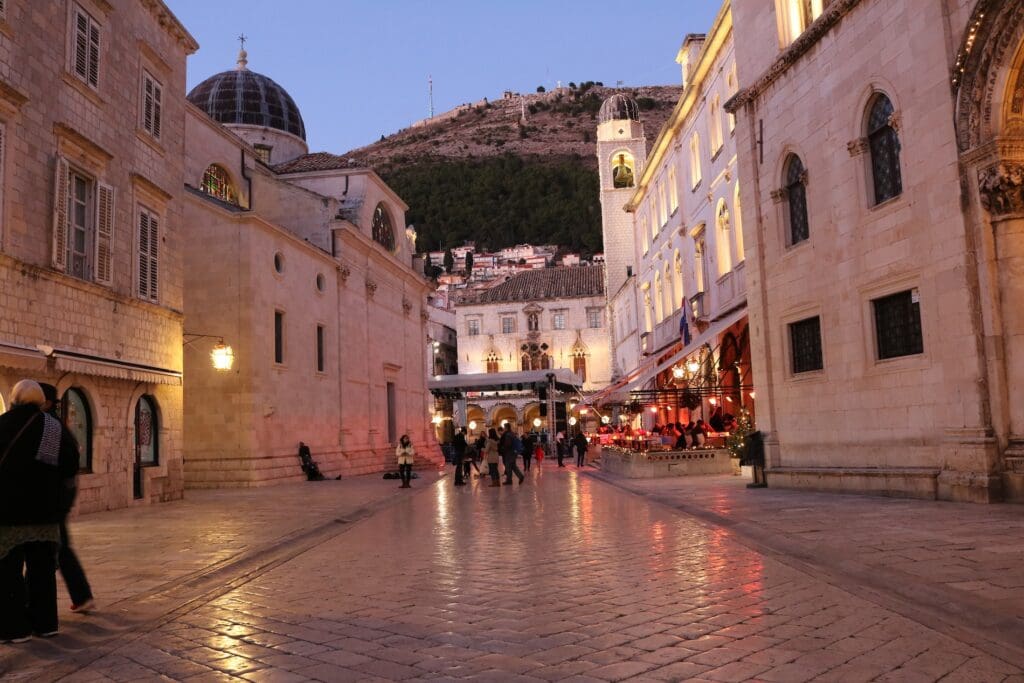
Because I returned over several outings, I also saw Old Town after dark. The polished stone streets reflected the lights from the surrounding buildings, and the holiday decorations gave the squares and narrow passages a different appearance than they had during the day.
Dubrovnik was preparing for its New Year’s Eve celebration, so a large stage partially blocked several views around Luža Square. Although the stage made photography more difficult, I enjoyed seeing the Christmas trees, angels, candles and wreaths displayed throughout Old Town.
Winter temperatures dropped into the mid-40s Fahrenheit at night, but the streets were still comfortable for walking with a jacket. The smaller winter crowds also made it easier to explore at my own pace while I continued recovering from my cold.
Dinner Inside Old Town Dubrovnik
During one of my evening visits, I ate outside at St. Blaise Konoba. Despite the cool temperature, the outdoor seating allowed me to continue enjoying the atmosphere inside the walls.
After some Croatian bread, I ordered Mediterranean-style chicken with fries and vegetables. The meal tasted great, although the portion was smaller than I expected.
Places I Missed in Old Town Dubrovnik
This trip took place before I started a travel blog and before I became good at planning efficient sightseeing routes. I enjoyed wandering without a schedule, but looking back at the map and my photographs, I can see that I either missed or did not properly explore several important places.
If I planned the visit today, I would make time for:
The Jesuit Stairs and Church of St. Ignatius
The Franciscan Monastery, including its cloister and historic pharmacy
The Dominican Monastery
The museum inside Rector’s Palace
The interior and treasury of Dubrovnik Cathedral
A closer visit to Sponza Palace
These are the places I would add if I were planning the same visit today. Together, they would create a more complete Old Town itinerary than the one I followed.
Practical Tips for Visiting Old Town Dubrovnik
Old Town is free to enter. Separate tickets are required for the City Walls, museums and certain attractions.
Pile Gate is the most convenient entrance when approaching from the western side of Dubrovnik. Ploče Gate provides access from the east.
Wear comfortable shoes. Stradun is relatively level, but many side streets contain steep stone steps.
The narrow streets can be confusing. A saved offline map is useful, although getting temporarily turned around was part of the experience for me.
Allow at least half a day for the streets and major exteriors. A full day or several outings would be better if you want to enter museums, churches and monasteries.
Walking the City Walls first gave me a useful overview of Old Town. If completing both on the same day, consider taking a break before beginning the street-level sightseeing.
Check current admission prices and operating hours directly with the individual attractions or the Dubrovnik Tourist Board.
Old Town Dubrovnik Walking Tours
I explored Old Town independently, and it is possible to see the major streets and exterior landmarks without a guide. A general history-focused walking tour could be helpful for visitors who want more context about the Republic of Dubrovnik, its churches and its palaces.
There are also many Game of Thrones tours. Since I have never watched the series, those tours have little appeal to me. I would choose a general Old Town or history-focused tour instead.
Is Old Town Dubrovnik Worth Visiting?
Old Town Dubrovnik was absolutely worth visiting. Walking the City Walls was the highlight of my time in the city, but exploring the streets inside the walls completed the experience. Stradun, the narrow side streets, the quiet interior of St. Blaise Church and the return visits after dark made Old Town feel different from any historic district I had previously visited.
I did not see everything, and I would plan the route much differently today. Even with those omissions—and while recovering from a cold—Old Town became one of my most memorable early experiences inside a walled city.
Related Content
Share this:
- Share on X (Opens in new window) X
- Share on Facebook (Opens in new window) Facebook
- Share on LinkedIn (Opens in new window) LinkedIn
- Share on Pinterest (Opens in new window) Pinterest
- Share on Tumblr (Opens in new window) Tumblr
- Share on WhatsApp (Opens in new window) WhatsApp
- Share on Reddit (Opens in new window) Reddit
- Print (Opens in new window) Print