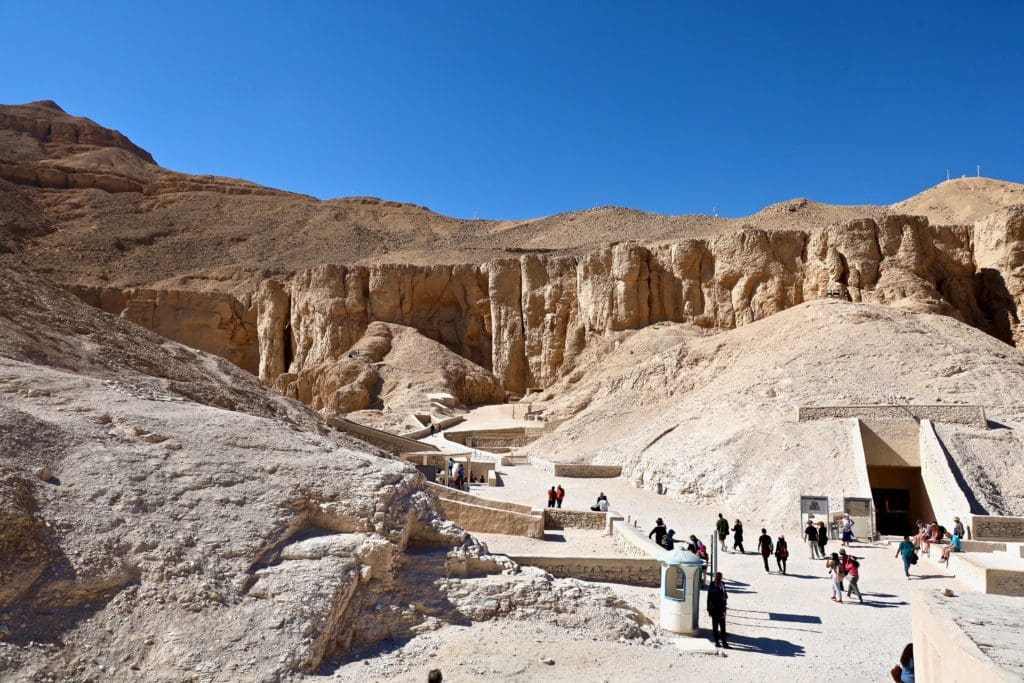
Luxor’s Valley of the Kings – Egypt’s Best Attraction
What is the Best Attraction in Egypt?
What is the best attraction in Egypt? Obviously, this is a very subjective question that is going to depend on a variety of factors. In December of 2022, I visited Luxor’s Valley of the Kings, which in my opinion, is the best attraction in all of Egypt.
Why the West Bank of the Nile Became Egypt’s Royal Cemetery
The Valley of the Kings is on the West Bank of the Nile River and served as the final resting place for many New Kingdom pharaohs’ tombs from the New Kingdom Period. The Ancient Egyptians chose to bury their dead on the West Bank of the Nile because they believed the sun died, or entered the underworld, each night when it set in the western sky. The next morning, when it rose in the eastern sky, they believed the sun was being reborn.
Discovering Luxor’s Valley of the Kings in Egypt
One of the reasons I feel that Luxor’s Valley of the Kings is Egypt’s best attraction is because the tombs are in such great condition. Dating back to 1550 BC, the tombs of the Valley of the Kings are over 3,500 years old. Despite their age, the burial art inside the tombs does not look its age as they were sealed shut for thousands of years.
The Howard Carter Discovery that Changed Egyptian Archaeology
The Valley of the Kings became well-known when Howard Carter discovered the tomb of King Tutankhamun in 1922 — one of the most famous Howard Carter discoveries in all of Egyptian archaeology. Carter continued his archaeological work for many years after and passed away in 1939 in London.
Although I had done some research on the Valley of the Kings, I was overwhelmed by the amazing writings and Ancient Egyptian hieroglyphics inside each tomb. The tombs are supposed to resemble the Underworld, and construction typically began on each pharaoh’s tomb when they received their crown.
Why Luxor’s Valley of the Kings Is Egypt’s Best Attraction
According to Nermeen, my guide, each corridor was decorated with hieroglyphic scripture from the Egyptian Holy Books. At the end of the corridor was a tomb, or a false tomb, to fight against tomb raiding, where the sarcophagus (right photo) of the deceased pharaoh was located. The purpose of these tombs was to ensure that the deceased pharaoh was able to pass to the Underworld, where they would live for eternity.
The photo below (left) shows the Tomb of Rameses IV. Inside Rameses IV’s tomb, there are multiple areas where the corridor widens. The wider areas have some of the most impressive examples of Egyptian burial art.
The tomb of Rameses V and Rameses VI is the most spectacular at Luxor’s Valley of the Kings. Below is the ceiling of the burial chamber of the tomb of Rameses V and VI. The ceiling features black-and-gold artwork depicting the Goddess Nut and passages from the Book of the Night and the Book of the Day.
The amount of hieroglyphic scripture written in the tombs is one of the most impressive parts of Egypt’s top tourist attraction. Most of the tombs located inside Luxor’s Valley of the Kings feature hundreds of hieroglyphic passages carved by hand over 3,500 years ago without the use of modern technology or lighting. Below is an example of some of the writing inside the Tomb of Rameses V and VI.
In addition to the awe-inspiring burial art, Luxor’s Valley of the Kings also provides an opportunity to see the mummified body of King Tutankhamun, also known as King Tut. King Tutankhamun’s tomb was famously discovered by Howard Carter in 1922. Below is King Tut’s mummified body on display near the entrance to his burial chamber.
There is so much to learn during a visit to Luxor’s Valley of the Kings, which is Egypt’s top attraction. Each example of Egyptian burial artwork tells a story. In the photo below, Egyptian Gods and Goddesses Hapy, Qebehsenuef, Anubis, Thoth, Nephthys, and Serqet are depicted on the walls of the Tomb of Merenptah.
A visit to the Valley of the Kings is a life-changing experience. As of December 2022, I have been to 40+ countries. Luxor’s Valley of the Kings is one of my favorite places I have ever visited.
Luxor's Valley of the Kings - Egypt's Best Attraction - Table of Contents
- Why Luxor’s Valley of the Kings is Egypt’s Top Attraction
- What is the Best Way to See Luxor’s Valley of the Kings
- Updated 2025 Ticket Prices
- Visiting the Tomb of Rameses IV- KV 2
- Visiting the Tomb of Tutankhamun – KV 62
- Visiting the Tomb of Merenptah – KV 8
- Visiting the Tomb of Rameses I – KV 16
- Visiting the Tombs of Rameses V and Rameses VI – KV 9
- More Things to Do in Luxor and Nearby Attractions
- Final Thoughts
- Support Buzzin’ Around the World – Visit Our Affiliates
- Earning Points and Rewards
- Related Content
Disclaimer: Buzzin’ Around the World strives to provide accurate and up-to-date information based on our research at the time of publication. We respect all applicable laws and fair use principles. If you believe any information is incorrect or violates regulations, please contact us at buzzinaroundtheworld@gmail.com.
Affiliate Links and Reviews: We use affiliate links to generate income and may receive a commission at no additional cost to you when you use our links. We strive for honest and transparent reviews, even for products which we receive compensation.
Content Creation: Our content is based on our own travel experiences. All photos are our own unless otherwise stated. We sometimes utilize AI tools to assist with tasks like generating titles, summarizing content, and improving organization.
For more information: For more information, please click HERE to visit our private policy page. We can be reached at buzzinaroundtheworld@gmail.com.
What is the Best Way to See Luxor's Valley of the Kings
Planning Your Luxor Day Tour from Cairo
The best way to see Luxor’s Valley of the Kings is to take a tour. For tourists staying in Luxor, many tours begin and end in Luxor City. During my visit, I stayed in Cairo but still wanted to visit Egypt’s top attraction. I decided to book a Cairo to Luxor tour and day trip to the Valley of Kings. My tour included round-trip air travel from Cairo International Airport to Luxor. I found that a day tour was plenty of time to experience Luxor’s Valley of the Kings.
When I arrived in Luxor, I was greeted by a wonderful guide named Nermeen. To read an entire summary of my day tour to Luxor, click HERE. The Valley of the Kings was just one of the locations that I toured with Nermeen. Other attractions during my Luxor tour are posted at the bottom of the page.
Updated 2025 Ticket Prices
The entrance fees to Luxor’s Valley of the Kings can be a little confusing.
As of October 2025, a standard entrance ticket (E£ 750 ≈ US $15) grants visitors access to any three of the tombs.
However, several famous tombs require separate add-on tickets:
King Tutankhamun (KV62) – E£ 700 (≈ US $14)
Rameses V and VI (KV9) – E£ 220 (≈ US $4)
Seti I (KV17) – E£ 2,000 (≈ US $40)
Even if you only want to visit the tombs of King Tut, Seti I, and Rameses V and VI, you still need to purchase the main entrance ticket.
Prices can change without notice, so confirm the latest rates on the Egyptian Ministry of Tourism and Antiquities website before visiting.
Nermeen recommended visiting the tombs of Rameses IV, Merenptah, and Rameses I. These tombs were the three that were included with the entrance ticket. In addition to those tombs, I paid for two extra tombs, Tutankhamun and Rameses V/VI. With limited time and limited funds, I chose not to pay the E£ 2,000 to visit the tomb of Seti I.
Linked below are multiple packages and tours that feature the Valley of the Kings. Please note that I am an affiliate of Viator. If you purchase a package using one of my links, I will receive a small commission. This commission is at no additional cost to you.
🎟️ Tickets & Opening Hours – Luxor’s Valley of the Kings (2025)
| Category | Price (EGP) | Approx. USD | Details |
|---|---|---|---|
| Main Entrance Ticket | 750 | $15 | Includes access to any three tombs (except special tombs below). |
| King Tutankhamun (KV62) | 700 | $14 | Add-on ticket required; see Tut’s mummy inside. |
| Rameses V & VI (KV9) | 220 | $4 | Stunning ceiling art from the Book of the Day and Book of the Night. |
| Seti I (KV17) | 2,000 | $40 | Widely considered the most elaborate tomb in Egypt; no foreign student discount. |
| Student Discount (Main Ticket) | 50% off (E£ 375) | – | Valid with ISIC student card. |
⏰ Opening Hours:
Summer (Apr–Sept): 6:00 AM – last entry 5:00 PM
Winter (Oct–Mar): 6:00 AM – last entry 4:00 PM
(Hours based on official Ministry site; times may vary during Ramadan.)
📍 Location: West Bank of the Nile, near Deir el-Bahari and the Temple of Hatshepsut
🔗 Official Site: Egyptian Ministry of Tourism and Antiquities (for latest ticket prices & updates)
Visiting the Tomb of Rameses IV - KV 2
Nermeen, my guide, recommended that the first tomb I should visit was KV 2, which is the tomb of Rameses IV. This tomb would count as one of the three tombs that were included with my standard entrance ticket.
The tomb of Rameses IV consists of multiple corridors leading to the main burial chamber.
On the walls are hieroglyphics and burial art from a variety of Ancient Egyptian Holy Texts, including the Book of Caverns, the Book of Gates, and the Book of the Dead.
Every inch of Rameses IV’s tomb is covered in art, including depictions of pharaoh burial chambers, starry ceilings, and protective deities.
The next tomb that I visited during my tour of Egypt’s top attraction, the Valley of the Kings, was KV 62, King Tutankhamun’s tomb. The tomb of Rameses V and VI (KV9) lies nearby, and its excavation debris covered King Tut’s entrance, helping preserve it for millennia.
I had seen photos of King Tut’s mummified body on the Internet, but it was a surreal experience to be seeing it in person.
Inside the burial chamber, the walls depict the Opening of the Mouth ritual, where Ay performs the ceremony to allow Tutankhamun to breathe in the afterlife. Goddess Nut greets the king, while twelve baboons represent the twelve hours of night from the Amduat—a text describing the sun’s nightly journey through the Underworld.
On the back wall, King Tut is seen with his Ka (soul), Goddess Nut, and Osiris, the God of the Underworld.
The sarcophagus holds three coffins, including the famous solid-gold coffin that contained King Tut’s mummy for over 3,000 years.
Early research once suggested that Queen Nefertiti’s tomb might be hidden behind Tutankhamun’s burial chamber, but this theory has since been disproven by radar scans conducted in 2018.
Visiting the Tomb of Merenptah - KV 8
The next tomb I visited at Egypt’s top attraction, the Valley of the Kings, was the tomb of Merenptah. Above its entrance is artwork depicting the Egyptian Sun Disk, and inside are scenes from the Book of Gates, describing the Ka’s journey through the Underworld past a series of gates guarded by goddesses.
One of the best examples of Egyptian burial art shows Merenptah being greeted by Ra, the God of the Sun.
Merenptah was buried in four stone sarcophagi, possibly designed to deter tomb robbers. Visitors should be cautious of guards offering access to restricted areas for tips—these areas are off-limits to protect the tombs from damage.
The burial chamber features a ceiling of stars and scenes from the Book of the Dead, adding to the mystical atmosphere of this ancient site.
The tomb of Rameses I was the third included in my general entrance ticket. After walking down two steep staircases, I entered the burial chamber of Rameses I, which features some of the best examples of Egyptian burial art.
Behind the sarcophagus, Rameses I is depicted with Atum-Ra-Khepri, symbolizing the rising sun and rebirth.
Nearby, Ptah, the creator god, is shown wrapped like a mummy.
The Book of Gates appears throughout, showing Rameses I greeted by deities. Though smaller than others, KV16 is beautifully preserved and an underrated stop within the Valley of the Kings.
Visiting the Tombs of Rameses V and Rameses VI - KV 9
The final tomb I visited was KV 9, the Tomb of Rameses V and Rameses VI, the most spectacular tomb in Luxor’s Valley of the Kings, located on the Luxor West Bank. Entrance requires an extra ticket, and it is well worth it.
Inside, the pillared chamber is overwhelming in scale and beauty, covered with artwork from the Book of Caverns, the Book of the Earth, the Book of Gates, and the Amduat (Imydwat)—texts describing Ra’s nightly journey through the Underworld.
Figures like Thoth, the ibis-headed god of wisdom, appear in detailed carvings. The ceilings are masterpieces, painted deep blue with golden stars, representing the Book of the Day and Book of the Night.
In the burial chamber, the inner sarcophagus of Rameses VI rests before art from the Book of Gates, while the outer sarcophagus, partially reconstructed, is backed by scenes from the Book of the Earth, telling of the creation of the Sun Disk.
I spent about 45 minutes exploring this tomb, wishing I had more time. It was the perfect finale to my Luxor day trip from Cairo, one of the most memorable Egypt tomb tours I have ever taken.
More Things to Do in Luxor and Nearby Attractions
If you’re visiting the West Bank of Luxor, you can easily combine your Valley of the Kings tour with nearby sites like the Temple of Hatshepsut, the Colossi of Memnon, and the Karnak Temple. These attractions make Luxor Egypt one of the most rewarding destinations for travelers interested in ancient history and archaeology.
Final Thoughts
I had a great time during my visit to Egypt’s top attraction, Luxor’s Valley of the Kings, on the West Bank Luxor. Luxor is a place I would gladly return to, as I only saw five of the many tombs. Each one told a story that has survived for over three millennia, making this one of the most awe-inspiring sites in all of Egypt.
Affiliate Partner of the Month – Fourthwall
Fourthwall powers our brand-new Buzzin’ Around the World Merch Shop. Pick up a tee, hoodie, or sticker. All profits will help me continue to run this site and deliver great content!
Buzzin Around the World's Merch Shop
Want to Launch Your Own Merch Line?
Scroll to the bottom of our Fourthwall page and tap “Start Your Own Store.” That’s a referral link—if you sign up, Fourthwall rewards me with store credit I can use to buy more gear (at no extra cost to you). We only recommend tools we use and love.
Earn $200 in Travel Rewards with the Capital One VentureOne Rewards Card
The Capital One VentureOne Rewards Card is one of the few rewards cards that does not charge an annual fee. Cardholders can earn 1.25 points for every dollar spent while enjoying 0% APR for 15 months.
Currently, Capital One is offering a signup bonus of 20,000 points (worth $200 in travel rewards) when the cardholder spends $500 in the first three months. If you are interested in this card, I would appreciate it if you would sign up with the link below, as I earn a referral bonus of 10,000 points. Those points are worth $100 in travel rewards and will help me continue to bring great content to Buzzin’ Around the World.
Once again, the Capital One VentureOne card is one of the few reward cards without an annual fee and is the perfect card for someone who is just starting to get into the travel points game.
Related Content
Share this:
- Share on X (Opens in new window) X
- Share on Facebook (Opens in new window) Facebook
- Share on LinkedIn (Opens in new window) LinkedIn
- Share on Pinterest (Opens in new window) Pinterest
- Share on Tumblr (Opens in new window) Tumblr
- Share on WhatsApp (Opens in new window) WhatsApp
- Share on Reddit (Opens in new window) Reddit
- Print (Opens in new window) Print