Chichén Itzá Day Trip from Cancún: Is It Worth It?
Why Visit Chichén Itzá on a Cancún Trip?
Why should you take a day trip to Chichén Itzá from Cancún? That is a question many travelers ask themselves when visiting the Yucatán Peninsula and the beaches of Cancún. The answer, at least for me, is simple: Chichén Itzá is one of the most impressive archaeological sites I have ever visited.
For travelers considering a Chichén Itzá day trip from Cancún, this experience offers a dramatic contrast to Cancún’s beach resorts. In a single day, you can experience one of the New Seven Wonders of the World, learn about ancient Maya culture from knowledgeable local guides, and see firsthand why this site continues to fascinate visitors from around the world.
A Day Trip to Chichén Itzá from Cancún: Is It Worth It? - Table of Contents
- Why Visit Chichén Itzá on a Cancún Trip?
- What Is Chichén Itzá and Why Is It Important?
- How Far Is Chichén Itzá from Cancún?
- Tour vs Renting a Car to Chichén Itzá
- My Chichén Itzá Tour Experience with Amigo Tours
- Entering Chichén Itzá and Touring with Rodrigo
- The Temple of Kukulkan (El Castillo)
- The Temple of Warriors
- The Great Ball Court
- Cenote Stop, Lunch, and the Pace of the Day
- Is a Chichén Itzá Day Trip from Cancún Worth It?
- Chichén Itzá,Tours and Packages
- Support Buzzin’ Around the World – Visit Our Affiliates
- Earning Points and Rewards
- Related Content
Disclaimer: Buzzin’ Around the World strives to provide accurate and up-to-date information based on our research at the time of publication. We respect all applicable laws and fair use principles. If you believe any information is incorrect or violates regulations, please contact us at buzzinaroundtheworld@gmail.com.
Affiliate Links and Reviews: We use affiliate links to generate income and may receive a commission at no additional cost to you when you use our links. We strive for honest and transparent reviews, even for products which we receive compensation.
Content Creation: Our content is based on our own travel experiences. All photos are our own unless otherwise stated. We sometimes utilize AI tools to assist with tasks like generating titles, summarizing content, and improving organization.
For more information: For more information, please click HERE to visit our private policy page. We can be reached at buzzinaroundtheworld@gmail.com.
What Is Chichén Itzá and Why Is It Important?
Chichén Itzá is an ancient Maya city that was once one of the most important centers in the Maya world. Rather than being part of a single empire, the Maya civilization was made up of independent city-states, and Chichén Itzá played a major role in regional trade, politics, and culture.
The site was settled as early as around 600 CE, with many of its most famous structures constructed between roughly 800 CE and 1200 CE. Over time, Chichén Itzá declined, likely due to a combination of environmental stress, political change, and shifting trade routes. Today, it stands as one of the best-preserved and most visited archaeological sites in Mexico.
How Far Is Chichén Itzá from Cancún?
One of my first questions when planning my visit was, “How do you get to Chichén Itzá from Cancún?” Chichén Itzá is located a little over 120 miles (200 km) from Cancún, and the drive typically takes just over two hours, depending on traffic and your starting point.
Because of the early start and long return time, most visitors either rent a car or book a guided tour. After weighing my options, I decided to take a tour rather than drive myself.
Tour vs Renting a Car to Chichén Itzá
Since Chichén Itzá is a long day trip from Cancún, I had to choose between renting a car or joining a guided tour. I ultimately decided to book a tour, and I’m glad I did.
The tour company I chose was Amigo Tours, and I give them my highest recommendation. Booking a Chichén Itzá tour took the stress out of transportation and timing, and having a knowledgeable guide made a huge difference in understanding what I was seeing once we arrived at the ruins.
The Amigo Tours bus picked me up at 7:20 a.m. outside my hotel, which served as the meeting point. I was warmly greeted by our guide, Marco, and our driver, Victor.
On the bus, we had assigned seats, and I was happy to see that I had a row to myself. The rest of the hotel pickups took some time, as Cancún is fairly spread out, and I felt bad for some passengers who had been picked up much earlier than I had.
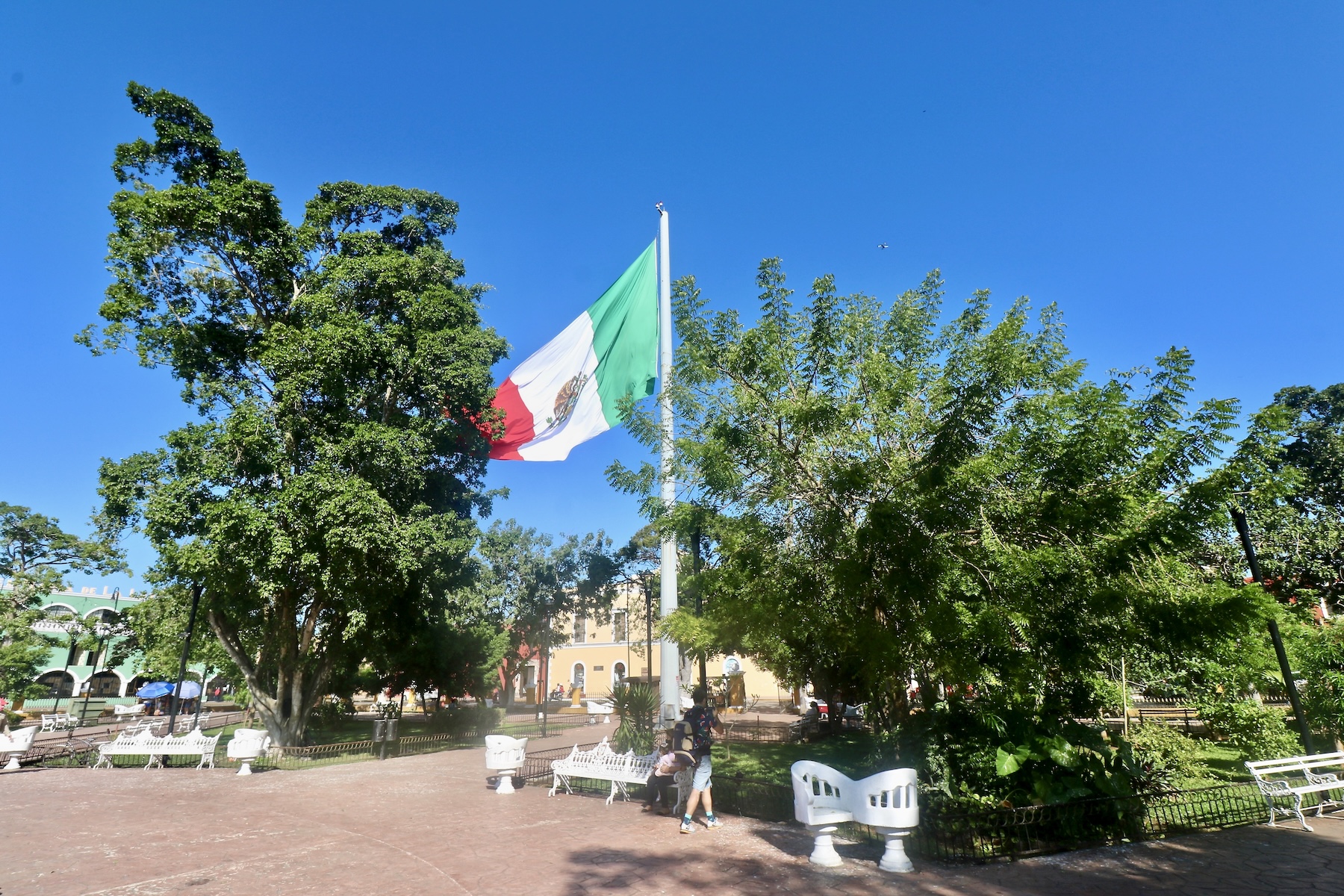
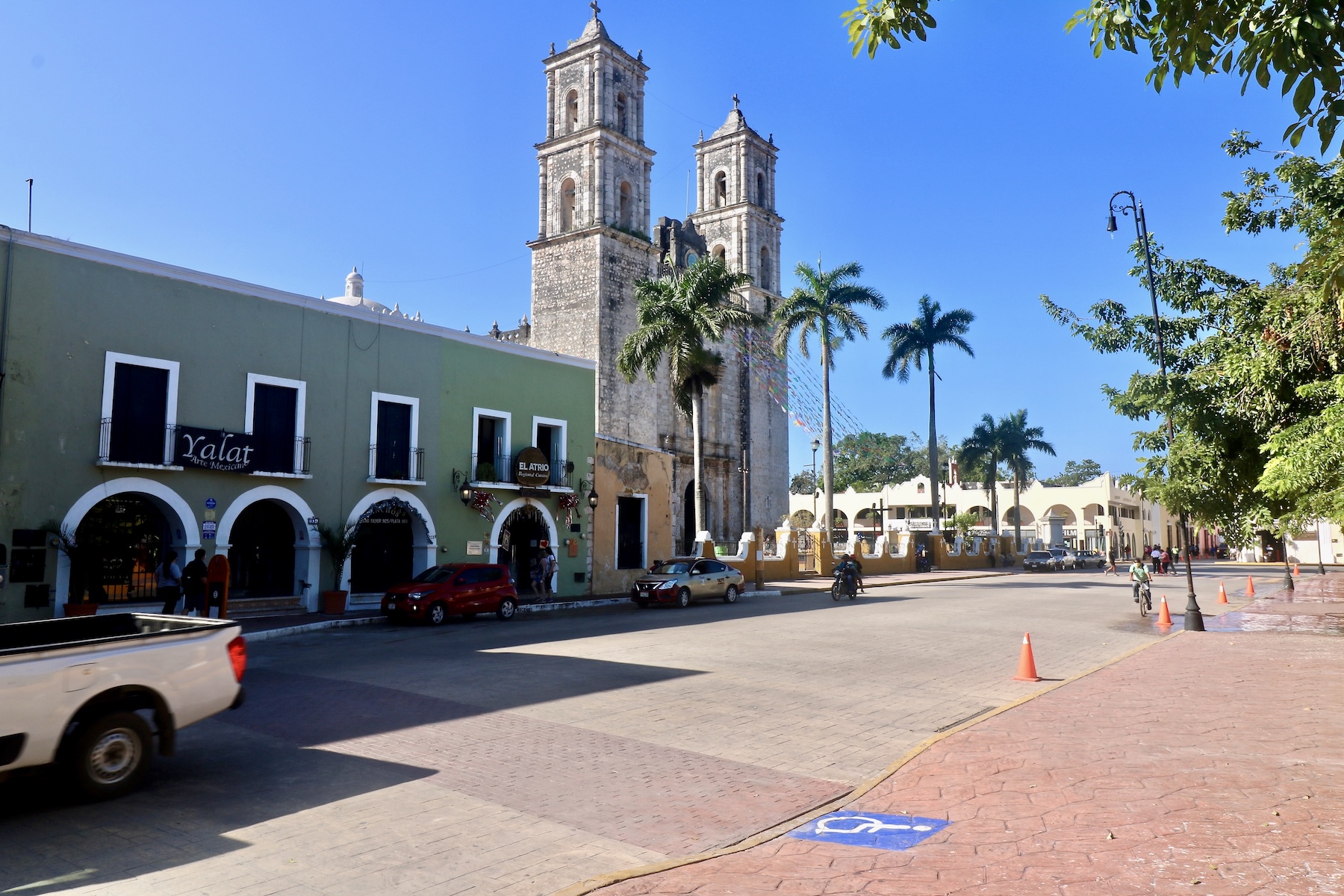
About halfway through the journey, we stopped in the colonial town of Valladolid, which was a welcome break from the long drive. As we continued toward Chichén Itzá, Marco shared background information about the Maya and the region. I ended up taking five full pages of notes during the drive.
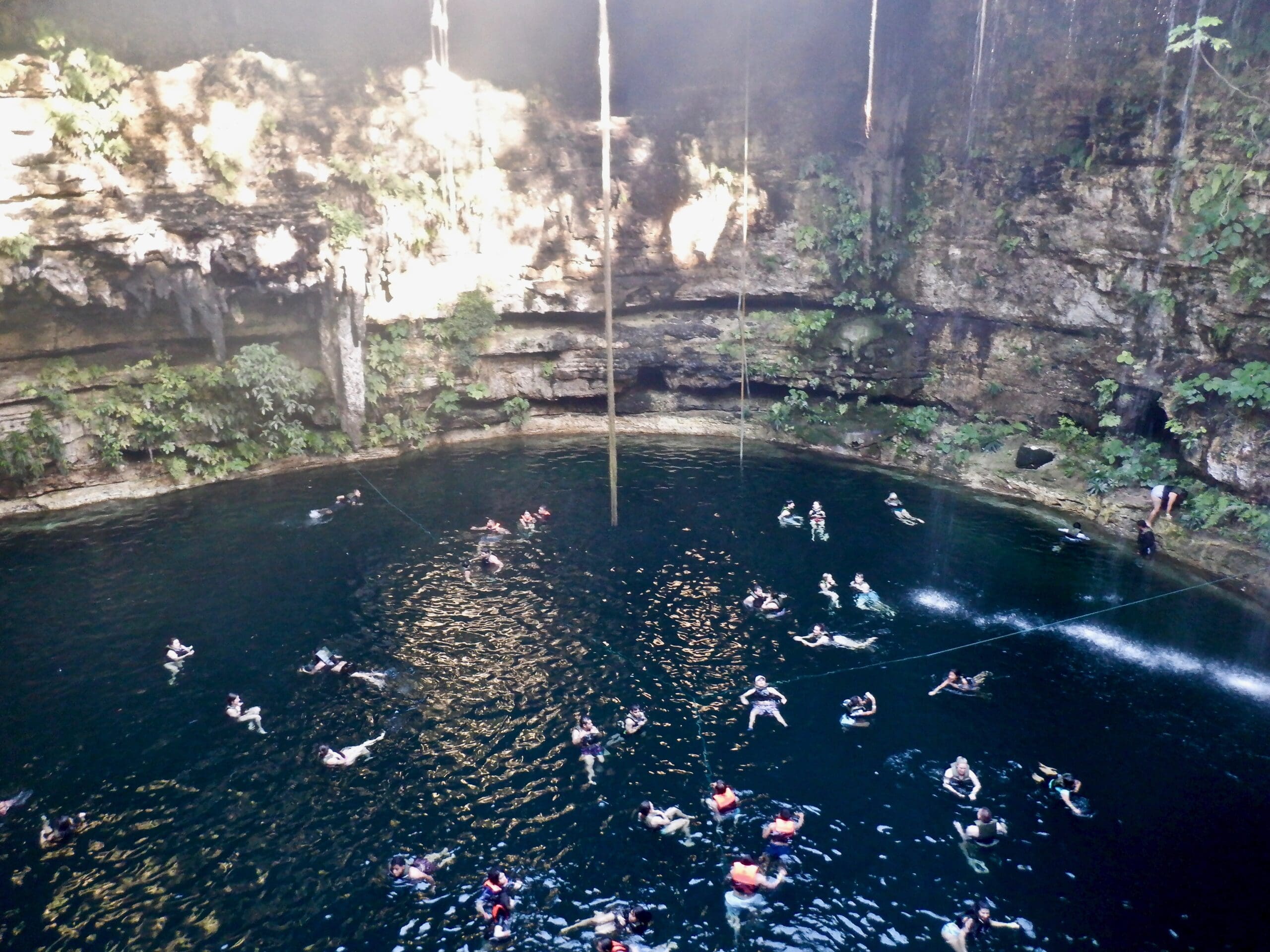
Once we arrived at Chichén Itzá, we spent around three hours touring the ruins. After the guided portion of the visit, we boarded the bus again and stopped at a local restaurant for an authentic Maya lunch. On the way back to Cancún, the tour also included a stop at a sacred cenote for a quick swim.
All in all, the tour lasted more than 12 hours, making it a long day, but absolutely worth it. Chichén Itzá remains one of the most fascinating places I have ever visited.
Entering Chichén Itzá and Touring with Rodrigo
When we arrived at Chichén Itzá, Marco passed out our tickets and divided us into smaller groups. At the time of my visit, the world was at the height of the COVID-19 pandemic, and Chichén Itzá was operating under capacity limits, which meant far fewer visitors than usual.
Tour groups were kept small, and we were introduced to additional guides. I was assigned to Rodrigo’s group, and he was, without a doubt, one of the best guides I’ve ever toured with. His explanations made the site come alive, and many of the stories he shared stayed with me long after the visit.
The Temple of Kukulkan, also known as El Castillo, is the most iconic structure at Chichén Itzá and the focal point of any visit. In 2007, it was named one of the New Seven Wonders of the World.
Rodrigo explained that the pyramid visible today was built over earlier structures, a common practice at major Maya ceremonial centers. Each phase of construction added another layer, creating the stepped pyramid that dominates the site today.
Each side of the pyramid has 91 steps, and when you include the final step at the top platform, the total comes to 365 steps, matching the number of days in a solar year. Rodrigo also explained how, during the spring and fall equinoxes, shadows appear along the staircase, creating the illusion of a serpent descending the pyramid, visually linking the structure to Kukulkan, the feathered serpent deity.
Another memorable moment came when Rodrigo demonstrated the acoustics of the temple. When we clapped in a specific rhythm, the echo that returned sounded remarkably like the call of the Resplendent Quetzal, a bird sacred to the Maya.
The Temple of Warriors
The Temple of Warriors is the second-most popular structure at Chichén Itzá. The temple is surrounded by hundreds of stone columns, many carved with figures often associated with Toltec-style warriors.
At the top of the steps sits a Chac Mool statue, a reclining figure commonly found throughout Mesoamerica. Rodrigo explained that these statues were associated with ritual offerings and were placed between the human world and the gods. He also pointed out how nearby pillars connect the Temple of Warriors symbolically to Kukulkan and the rest of the site.
One detail that stood out to me was the bluish staining visible on parts of the temple. Rodrigo explained that this coloration is closely associated with ritual sacrifice, noting that blue held strong symbolic meaning for the Maya and was often linked to ceremonial practices at sites like Chichén Itzá.
The Great Ball Court
The Great Ball Court was the final stop on our tour and immediately felt different from everything else we had seen. Measuring 545 feet long and 225 feet wide, it is one of the largest and best-preserved ball courts in ancient Mesoamerica.
Rodrigo explained that the game played here was known as Pok-A-Tok, a ritual ball game that carried deep cultural and religious meaning. The game used a heavy solid rubber ball, and teams competed on opposite sides of the court.
How the Maya Ball Game Was Played
According to Rodrigo, one objective of the game was to move the ball toward a stone ring mounted high on the wall, roughly 20 feet above the ground. What made the game especially difficult was that players generally did not use their hands or feet, instead striking the ball primarily with their hips, and in some versions also using other parts of the body such as the shoulders, knees, or elbows.
Rodrigo explained that because of the difficulty of play, matches could last for hours, turning them into major public events. Members of different social classes gathered to watch, with spectators positioned in designated areas around the court.
Standing inside the Great Ball Court made it easy to appreciate how physically demanding—and spectacular—this game must have been.
The Acoustics of the Great Ball Court
One of the most fascinating features of the Great Ball Court is its acoustics, and Rodrigo made sure we experienced them firsthand. When he clapped once from one end of the court, the sound echoed back and forth across the stone walls.
Rodrigo explained that the design of the court allows sound to travel exceptionally well, making it possible for voices—and even quiet noises—to be heard from one end to the other. To demonstrate this, he walked a considerable distance away and made a popping sound by smacking his cheek. Even from far away, the sound carried clearly.
Sacrifice and Symbolism at the Great Ball Court
Rodrigo also addressed a topic many visitors are curious about: sacrifice associated with the ball game. He explained that there is ongoing debate about who was sacrificed after important matches. While some interpretations suggest a member of the losing team, Rodrigo shared another view—that it may have been the winning team’s captain, and that sacrifice was considered an honor rather than a punishment.
He pointed out stone carvings along the walls of the Great Ball Court that depict scenes connected to the game, including imagery showing a beheaded figure with seven snakes emerging from the neck. Rodrigo emphasized that this imagery is symbolic, reflecting Maya beliefs and cosmology rather than serving as a literal play-by-play of events.
Cenote Stop, Lunch, and the Pace of the Day
After finishing our guided tour of Chichén Itzá, we headed to a local restaurant for lunch, which was included with the tour. The meal gave us a chance to rest, cool down, and recharge after several hours in the heat.
Later in the day, we stopped at a sacred cenote for a quick swim. While brief, the stop was refreshing and helped break up the long drive back to Cancún.
From early morning pickup to returning in the evening, the tour lasted over 12 hours. It was a long day, but the combination of ruins, guided explanations, food, swimming, and scenic stops made it feel well-paced rather than exhausting.
Is a Chichén Itzá Day Trip from Cancún Worth It?
A day trip to Chichén Itzá from Cancún is undeniably long and requires an early start. However, I found it absolutely worth it. Seeing one of the New Seven Wonders of the World, learning from knowledgeable local guides, and experiencing Maya history firsthand made this one of the highlights of my time in Mexico.
If you want to break up your Cancún beach trip with culture, history, and something truly different, this is a day trip I would strongly recommend.
Chichén Itzá Tours and Packages from Cancún
Having a knowledgeable guide made a huge difference during my visit to Chichén Itzá. Without the explanations provided by Marco and Rodrigo, many of the details behind the ruins would have been easy to miss.
I booked directly with Amigo Tours and do not earn any commission if you book with them. If you choose to explore other options, I’ve also included tours through Viator. As a Viator affiliate, I may earn a small commission at no additional cost to you.
Affiliate Partner of the Month – Fourthwall
Fourthwall powers our brand-new Buzzin’ Around the World Merch Shop. Pick up a tee, hoodie, or sticker. All profits will help me continue to run this site and deliver great content!
Buzzin Around the World's Merch Shop
Want to Launch Your Own Merch Line?
Scroll to the bottom of our Fourthwall page and tap “Start Your Own Store.” That’s a referral link—if you sign up, Fourthwall rewards me with store credit I can use to buy more gear (at no extra cost to you). We only recommend tools we use and love.
Earn $200 in Travel Rewards with the Capital One VentureOne Rewards Card
The Capital One VentureOne Rewards Card is one of the few rewards cards that does not charge an annual fee. Cardholders can earn 1.25 points for every dollar spent while enjoying 0% APR for 15 months.
Currently, Capital One is offering a signup bonus of 20,000 points (worth $200 in travel rewards) when the cardholder spends $500 in the first three months. If you are interested in this card, I would appreciate it if you would sign up with the link below, as I earn a referral bonus of 10,000 points. Those points are worth $100 in travel rewards and will help me continue to bring great content to Buzzin’ Around the World.
Once again, the Capital One VentureOne card is one of the few reward cards without an annual fee and is the perfect card for someone who is just starting to get into the travel points game.
Related Content
Share this:
- Share on X (Opens in new window) X
- Share on Facebook (Opens in new window) Facebook
- Share on LinkedIn (Opens in new window) LinkedIn
- Share on Pinterest (Opens in new window) Pinterest
- Share on Tumblr (Opens in new window) Tumblr
- Share on WhatsApp (Opens in new window) WhatsApp
- Share on Reddit (Opens in new window) Reddit
- Print (Opens in new window) Print