Sanjusangen-do Temple in Kyoto: My Visit to the 1,001 Kannon Statues
Sanjusangen-do Temple was one of the most unique temple experiences from my time in Kyoto. It was not the largest temple complex I visited, and it did not take a full day to see, but the inside of the main hall was something I will never forget.
The highlight of Sanjusangen-do Temple is the long wooden hall filled with the central seated Thousand-Armed Kannon and 1,000 standing Kannon statues, often described together as the temple’s 1,001 Kannon statues. Photography is not allowed inside, so I do not have photos of the most impressive part of the visit. That was disappointing from a travel-blogging point of view, but I respected the rule and only used my own exterior photos on this page.
Even without interior photos, Sanjusangen-do was absolutely worth visiting. The rows of statues were intense, and at times it felt like all 1,001 figures were looking directly at me.
Sanjusangen-do Temple - Table of Contents
- Is Sanjusangen-do Temple Worth Visiting?
- Quick Visitor Information for Sanjusangen-do Temple
- What Makes Sanjusangen-do Temple Special?
- My Visit to Sanjusangen-do Temple
- Walking the Grounds, Garden, and Bell at Sanjusangen-do
- Are Photos Allowed Inside Sanjusangen-do Temple?
- Sanjusangen-do Temple Tickets, Hours, and How to Get There
- Sanjusangen-do Temple Tours and Kyoto Itineraries
- FAQ: Visiting Sanjusangen-do Temple in Kyoto
- Final Thoughts on Visiting Sanjusangen-do Temple
- Support Buzzin’ Around the World – Visit Our Affiliates
- Earning Points and Rewards
- Related Content
Disclaimer: Buzzin’ Around the World strives to provide accurate and up-to-date information based on our research at the time of publication. We respect all applicable laws and fair use principles. If you believe any information is incorrect or violates regulations, please contact us at buzzinaroundtheworld@gmail.com.
Affiliate Links and Reviews: We use affiliate links to generate income and may receive a commission at no additional cost to you when you use our links. We strive for honest and transparent reviews, even for products which we receive compensation.
Content Creation: Our content is based on our own travel experiences. All photos are our own unless otherwise stated. We sometimes utilize AI tools to assist with tasks like generating titles, summarizing content, and improving organization.
For more information: For more information, please click HERE to visit our privacy policy page. We can be reached at buzzinaroundtheworld@gmail.com.
Is Sanjusangen-do Temple Worth Visiting?
Yes, Sanjusangen-do Temple is worth visiting, especially if you are interested in Kyoto temples, Buddhist art, or places that feel different from the city’s more famous outdoor temple grounds.
I would not describe Sanjusangen-do as a full half-day attraction. My visit took less than an hour, which felt like enough time to see the main hall, walk around the grounds, and take a few exterior photos. The main reason to visit is the experience inside the hall, but the grounds, garden, and bell are also worth a short walk before or after going inside.
The 1,001 Kannon statues were more powerful in person than I expected. Since they are lined up in long rows, the effect is almost overwhelming. I remember feeling like I was being watched by 1,001 people at the same time.
It was also a quiet visit. There were tourists, but there were also active worshippers, which made the inside feel more serious and respectful than some of the busier sightseeing spots in Kyoto.
Quick Visitor Information for Sanjusangen-do Temple
Location: Higashiyama area of Kyoto, Japan
Closest station: Shichijo Station
Walk from Shichijo Station: About 10 minutes
Time needed: About 30–60 minutes
Adult admission: ¥600
Main highlight: 1,001 Kannon statues inside the main hall
Photography inside: Not allowed
Best for: A short but memorable Kyoto temple visit
Sanjusangen-do is usually open from 8:30 a.m. to 5:00 p.m. from April 1 to November 15, and from 9:00 a.m. to 4:00 p.m. from November 16 to March 31. Final admission is typically 30 minutes before closing.
I visited Sanjusangen-do while staying in Kyoto. I was coming from my hotel in Arashiyama, which was not the most efficient starting point. Kyoto’s sights are a bit spread out, and at that point in my travels I was not as good at planning my days as I am now.
To get there, I took a taxi to Kyoto Station and then used the train to reach Shichijo Station. From Shichijo Station, Sanjusangen-do was an easy walk and simple to find.
What Makes Sanjusangen-do Temple Special?
Sanjusangen-do Temple is best known for the 1,001 Kannon statues inside the main hall. The center of the hall features a large seated Thousand-Armed Kannon, surrounded by rows of standing Kannon statues. The hall also includes 28 guardian deity statues, along with the famous wind and thunder gods, Fujin and Raijin.
The temple’s official name is Rengeo-in, but most visitors know it as Sanjusangen-do.
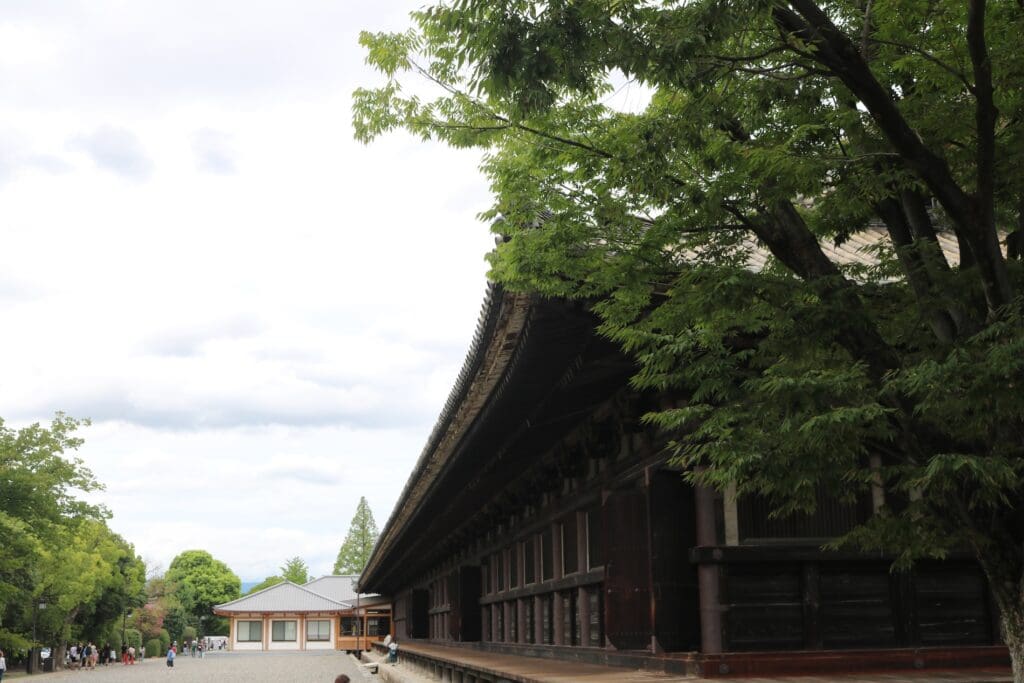
From the outside, the main hall is long and fairly simple. The inside is what makes the visit memorable. The scale of the display was intense, and it felt like the statues were all looking back at me.
There are also temple grounds to walk around before or after visiting the hall. Since photography is not allowed inside, the grounds, garden, and bell are the best places to take your own photos during a visit.
My Visit to Sanjusangen-do Temple
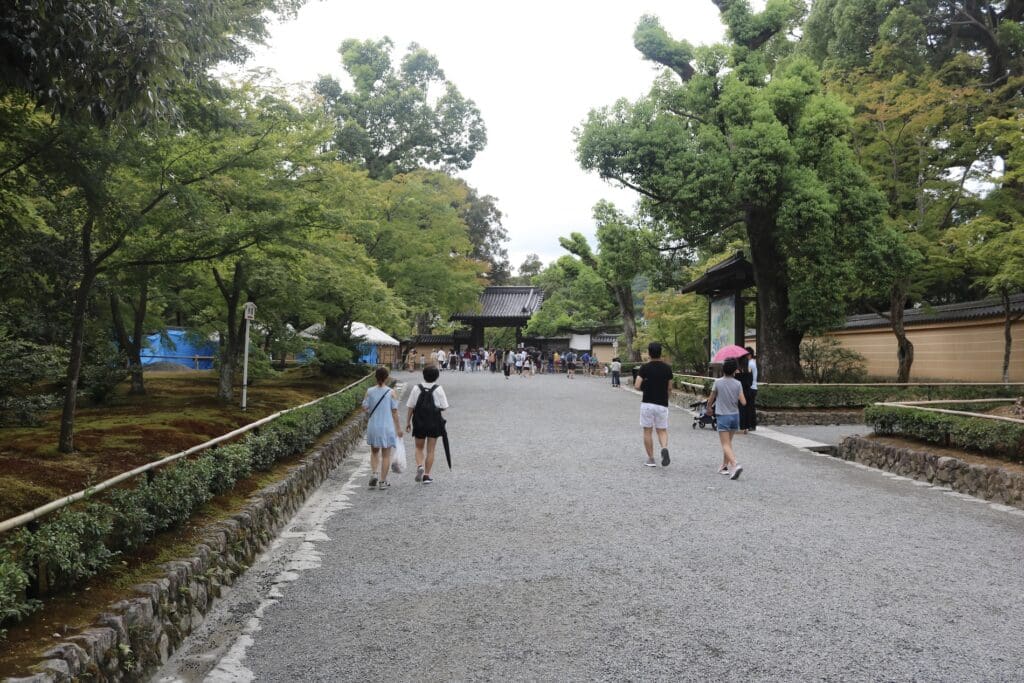
My visit to Sanjusangen-do was simple and fairly short. After walking from Shichijo Station, I entered the temple grounds, took some photos outside, and then went inside the main hall.
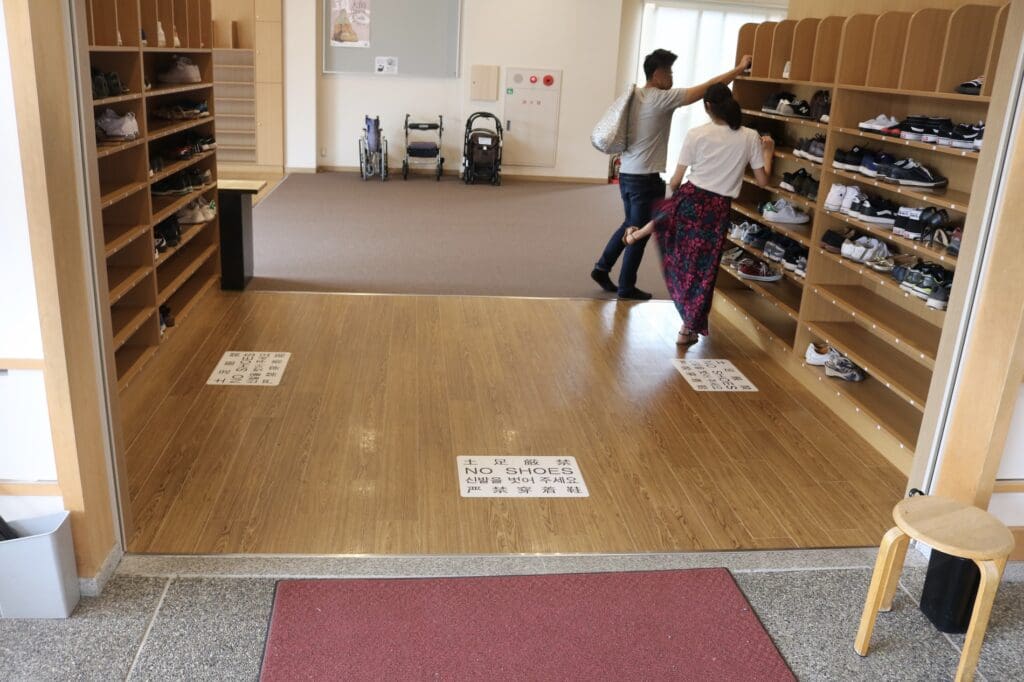
Before entering the interior area, I had to take off my shoes. This is common at some temples in Japan, and it also helped set the tone for the visit. Once inside, the atmosphere felt much quieter and more serious.
The main hall was the highlight. The rows of statues were intense, and I found myself looking across the long lines of figures as I walked through. Since the statues face outward, it really did feel like they were all looking back at me.
I also noticed active worshippers inside, which made the experience feel different from simply walking through a museum or tourist attraction. It was still a sightseeing stop for me, but it was also clearly a religious site for others.
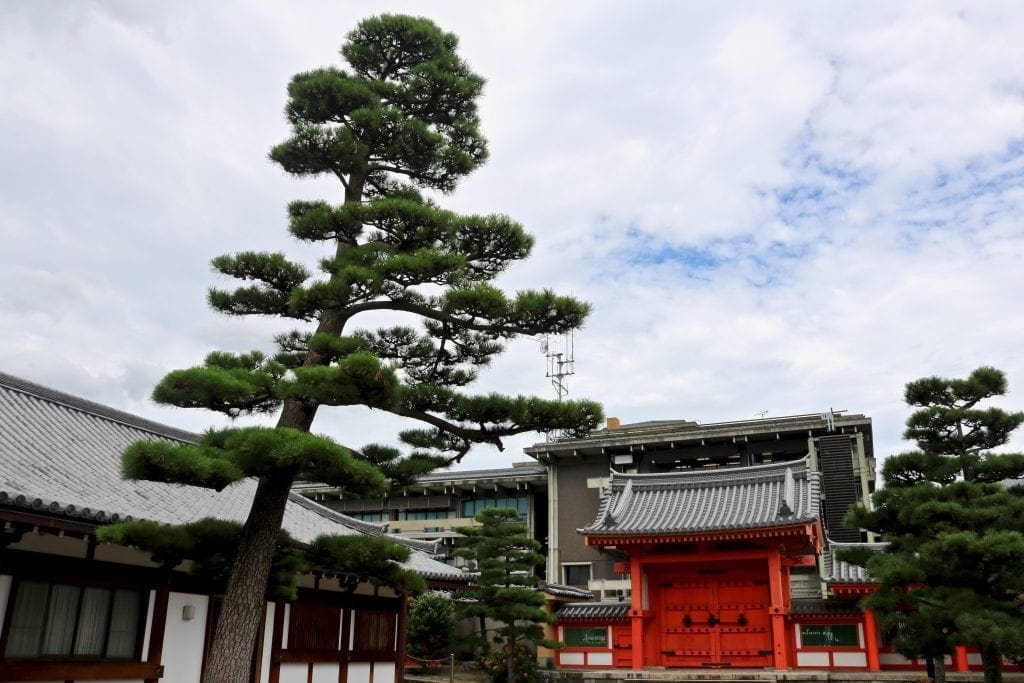
Since the main hall does not allow photography, I spent some time walking around the outside of Sanjusangen-do as well. The grounds are not huge, but they are peaceful and worth seeing before or after going inside.
This is also where I took most of my photos. I had pictures of the temple exterior, the garden area, and the large bell, but not the 1,001 Kannon statues themselves. That makes this page a little different from some of my other temple posts, because the most impressive part of the visit is the part I could not photograph.
I do not know the specific use of the bell at Sanjusangen-do, so I do not want to guess. In general, temple bells are an important part of Buddhist temple life in Japan, and seeing the bell added another visual detail to the visit.
The garden and bell are not the main reason to visit Sanjusangen-do, but they help round out the experience. I would not rush straight in and out of the main hall. If you are already there, it is worth taking a few extra minutes to walk the grounds.
Are Photos Allowed Inside Sanjusangen-do Temple?
No, photos are not allowed inside Sanjusangen-do Temple.
This was the most disappointing part of my visit because the 1,001 Kannon statues are the main reason to go. As a travel blogger, I always want to show readers what I saw, but this was one of those times where the rules were clear.
I do not have interior photos of the Kannon statues because I chose to respect the temple’s photography restrictions. The photos on this page are my own exterior photos from the temple grounds.
In a strange way, not being able to take photos made the visit more memorable. I only have the interior images in my mind, which is frustrating for this page but also part of what made the experience feel special.
Sanjusangen-do Temple is one of the easier Kyoto temples to visit if you are using public transportation. I walked from Shichijo Station, and the route was easy to follow.
Admission for adults is ¥600. The temple is usually open from 8:30 a.m. to 5:00 p.m. from April 1 to November 15, and from 9:00 a.m. to 4:00 p.m. from November 16 to March 31. Final admission is typically 30 minutes before closing.
Because Sanjusangen-do does not require a long visit, it can be added to a Kyoto sightseeing day. I visited Kinkaku-ji Temple and Fushimi Inari Taisha Shrine on the same day, although I would not necessarily say that was the best-planned route. Kyoto’s attractions are spread out, so it is worth looking at a map before trying to combine too many places.
Sanjusangen-do Temple Tours and Kyoto Itineraries
Sanjusangen-do can be visited independently, which is what I did. If you are comfortable using Kyoto’s train system, getting there from Shichijo Station is easy.
A guided tour may make sense if you want to combine Sanjusangen-do with other Kyoto highlights and avoid figuring out the logistics yourself. This can be helpful because Kyoto sights are not always close together, and trying to combine temples without a plan can lead to a lot of wasted time.
If you are booking a Kyoto temple tour, I would look for one that includes several sights in the same general area or clearly explains the transportation between stops. Sanjusangen-do is a great short stop, but it works best when it is part of a smart Kyoto itinerary.
Please note that I may earn a small commission if you book a tour using one of my affiliate links. This does not cost you anything extra and helps support Buzzin’ Around the World.
FAQ: Visiting Sanjusangen-do Temple in Kyoto
Is Sanjusangen-do Temple worth visiting?
Yes, Sanjusangen-do Temple is worth visiting. It does not take a long time to see, but the 1,001 Kannon statues make it one of the most memorable temple interiors I saw in Kyoto.
How long do you need at Sanjusangen-do Temple?
I would plan on about 30–60 minutes. My visit took less than an hour, which was enough time to see the main hall and walk around the grounds.
Can you take photos inside Sanjusangen-do Temple?
No, photography is not allowed inside the main hall. I only used my own exterior photos for this page because I wanted to respect the temple’s rules.
What is Sanjusangen-do Temple famous for?
Sanjusangen-do Temple is famous for its long wooden hall and the 1,001 Kannon statues inside. The center of the hall features a large seated Thousand-Armed Kannon, along with 28 guardian deity statues and the famous wind and thunder gods, Fujin and Raijin.
How do you get to Sanjusangen-do Temple?
I took the train to Shichijo Station and walked from there. The walk was easy, and the temple was simple to find.
Can you visit Sanjusangen-do, Kinkaku-ji, and Fushimi Inari on the same day?
Yes, that is possible, and I visited all three on the same day. However, Kyoto sights are spread out, so it is not the most efficient route unless you plan your transportation carefully.
Final Thoughts on Visiting Sanjusangen-do Temple
Sanjusangen-do Temple was a short visit, but it left a strong impression on me. The outside of the temple, the garden, the bell, and the grounds were all worth seeing, but the real reason to go is the main hall filled with 1,001 Kannon statues.
It was disappointing not being able to photograph the interior, especially because that is the part of the temple I most wanted to share. At the same time, I understand why the rule exists. Sanjusangen-do is not just a tourist attraction. It is also an active religious site, and the quiet atmosphere was part of what made the visit meaningful.
If you are planning a trip to Kyoto, I would not skip Sanjusangen-do. It is easy to visit from Shichijo Station, does not take a lot of time, and offers a completely different experience from Kyoto’s more famous outdoor temples and shrines.
Affiliate Partner of the Month – Fourthwall
Fourthwall powers our brand-new Buzzin’ Around the World Merch Shop. Pick up a tee, hoodie, or sticker. All profits will help me continue to run this site and deliver great content!
Buzzin Around the World's Merch Shop
Want to Launch Your Own Merch Line?
Scroll to the bottom of our Fourthwall page and tap “Start Your Own Store.” That’s a referral link—if you sign up, Fourthwall rewards me with store credit I can use to buy more gear (at no extra cost to you). We only recommend tools we use and love.
Earn $200 in Travel Rewards with the Capital One VentureOne Rewards Card
The Capital One VentureOne Rewards Card is one of the few rewards cards that does not charge an annual fee. Cardholders can earn 1.25 points for every dollar spent while enjoying 0% APR for 15 months.
Currently, Capital One is offering a signup bonus of 20,000 points (worth $200 in travel rewards) when the cardholder spends $500 in the first three months. If you are interested in this card, I would appreciate it if you would sign up with the link below, as I earn a referral bonus of 10,000 points. Those points are worth $100 in travel rewards and will help me continue to bring great content to Buzzin’ Around the World.
Once again, the Capital One VentureOne card is one of the few reward cards without an annual fee and is the perfect card for someone who is just starting to get into the travel points game.
Related Content
Share this:
- Share on X (Opens in new window) X
- Share on Facebook (Opens in new window) Facebook
- Share on LinkedIn (Opens in new window) LinkedIn
- Share on Pinterest (Opens in new window) Pinterest
- Share on Tumblr (Opens in new window) Tumblr
- Share on WhatsApp (Opens in new window) WhatsApp
- Share on Reddit (Opens in new window) Reddit
- Print (Opens in new window) Print