Can You See Jerusalem’s Holy Sites in One Day?
Is it Possible to See Jerusalem’s Holy Sites in One Day?
For those visiting Israel, a trip to the holy sites in Jerusalem is typically one of the highlights of their trip. But for travelers with limited time, I wondered if it is possible to see Jerusalem’s holy sites in one day. The answer is yes; it is possible to see the main holy sites of Jerusalem in one day.
Jerusalem is a holy city for followers of Judaism, Christianity, and Islam. The main sites that can be seen in one day include the Dome of the Rock, Western Wall, Church of the Holy Sepulchre, Tower of David, as well as the various quarters of the Old City of Jerusalem. For those interested in seeing any additional holy sites in Jerusalem, a second day would likely be needed—especially if you are planning a more relaxed Old City of Jerusalem tour or a detailed Church of the Holy Sepulchre tour.
It is important to remember that the Old City of Jerusalem is typically extremely crowded. During my visit, I spent time waiting in line to view some of the religious sites, specifically inside the Church of the Holy Sepulchre. Whether you are doing a Jerusalem day trip from Tel Aviv or staying in Jerusalem itself, you should be prepared for crowds and wait times.
Video Highlights of Visiting Jerusalem's Holy Sites in a Single Day
In this video, I share highlights from my one-day tour of Jerusalem’s holy sites, including the panoramic Mount Scopus viewpoint, our walk through the Jewish Quarter and Muslim Quarter, and time at both the Western Wall and the Church of the Holy Sepulchre. You’ll see how our guided Old City of Jerusalem tour moves efficiently between viewpoints, historic gates, and sacred churches, giving a realistic look at what you can experience in a single busy day in the Old City of Jerusalem. If you’re wondering what a Jerusalem day trip looks like in practice, this video is a great preview of the route, the crowds, and the atmosphere at these world-famous holy sites.
Visiting the Holy Sites in Jerusalem in One Day - Table of Contents
- Is it Possible to See Jerusalem’s Holy Sites in One Day?
- Video Highlights of Visiting Jerusalem in a Single Day
- Is a Guide Needed to See the Holy Sites in Jerusalem?
- My Tour of Jerusalem
- The Best Views of Jerusalem – The Mt. Scopus Viewpoint
- Entering Jerusalem Through the Jaffa Gate
- The Tower of David and the Jewish Quarter
- The Corinthian Columns of Jerusalem
- The Hurva Synagogue
- The Mount of Olives Jewish Cemetery
- The Dome of the Rock
- The Western Wall
- Walking Through the Muslim Quarter of the Old City of Jerusalem
- Following the Stations of the Cross
- The Church of the Holy Sepulchre
- Jerusalem Tours and Packages
- Support Buzzin’ Around the World – Visit Our Affiliates
- Earning Points and Rewards
- Related Content
Disclaimer: Buzzin’ Around the World strives to provide accurate and up-to-date information based on our research at the time of publication. We respect all applicable laws and fair use principles. If you believe any information is incorrect or violates regulations, please contact us at buzzinaroundtheworld@gmail.com.
Affiliate Links and Reviews: We use affiliate links to generate income and may receive a commission at no additional cost to you when you use our links. We strive for honest and transparent reviews, even for products which we receive compensation.
Content Creation: Our content is based on our own travel experiences. All photos are our own unless otherwise stated. We sometimes utilize AI tools to assist with tasks like generating titles, summarizing content, and improving organization.
For more information: For more information, please click HERE to visit our private policy page. We can be reached at buzzinaroundtheworld@gmail.com.
Is a Guide Needed to Visit the Holy Sites in Jerusalem?
One of the things I am often asked by my readers is, “Should I take a tour or see the sights on my own?” My advice is that it is always better to hire a guide or take a tour, as a local expert will know the best places for photos and be able to provide the tourist with additional information. For Jerusalem, I highly recommend hiring a guide or taking a tour. The Old City of Jerusalem has many narrow streets that can be difficult to navigate.
For those who are on a strict budget, it is possible to see the holy sites of Jerusalem without a guide. Just know that you will likely miss out on quite a bit of background information and context that a licensed guide can provide, especially on a Jerusalem day trip from Tel Aviv.
My One-Day Jerusalem Holy Sites Tour with Bein Harim
During my visit, I booked a tour with the company Bein Harim Tours. I used Bein Harim for multiple tours throughout Israel and found them to provide excellent service. My Old City of Jerusalem tour was paired with a visit to the Yad Vashem Holocaust Remembrance Center. We spent the morning and early afternoon touring the Old City of Jerusalem and then drove to Yad Vashem, where we spent two hours visiting the Holocaust Remembrance Center. Photos were not allowed at Yad Vashem, but I highly recommend visiting this powerful museum as part of a Jerusalem and Yad Vashem tour.
The tour began with a representative from Bein Harim picking me up from my hotel. Bein Harim Tours Jerusalem shuttles their clients to a central location where they meet their specific guides. Shuttling the passengers saves a lot of time, as the buses focus on a specific region of Jerusalem instead of having to drive all over the city.
Best Views of Jerusalem from Mount Scopus Viewpoint
For this tour, our central location was the Mount Scopus Viewpoint. According to our tour guide Udi, the Mount Scopus viewpoint offers some of the best views of Jerusalem. This viewpoint served as the meeting point for our tour. While we waited for all of our tourmates to arrive, we had the option of taking photographs and purchasing breakfast and coffee.
Once everyone arrived, Udi had us sit in the shade and went over the day’s itinerary. He also spent some time pointing out the main holy sites of Jerusalem. Pictured below is the Dome of the Rock. The Dome of the Rock is one of the most important Islamic holy sites in Jerusalem.
Udi also pointed out one of the holiest sites for members of the Christian faith, the Church of the Holy Sepulchre, which was built over the site where many Christians believe Jesus Christ was crucified and entombed.
Before we departed for the Old City of Jerusalem, Udi pointed out the Mount of Olives. For followers of Judaism, the Mount of Olives is the location where many believe the Messiah will appear. The Mount of Olives is also important to Christians because they believe it is the location where Jesus Christ ascended into heaven.
Entering Jerusalem Through the Jaffa Gate
Once everyone arrived for our tour, we left the Mount Scopus Viewpoint and drove to the Old City of Jerusalem. Sergei, our driver, dropped us off near the entrance to the Jaffa Gate, and Udi began leading us on a walking Old City of Jerusalem tour.
Udi told us an interesting story about the Jaffa Gate. Built into the walls completed in 1539 CE by the Ottoman Empire, the surrounding wall was breached in 1898 CE by the Ottoman authorities ahead of Emperor Wilhelm II of Germany’s visit to the Old City of Jerusalem. In addition to breaching the wall near the gate, part of the moat surrounding Old Jerusalem had to be filled in as well.
Tower of David and the Jewish Quarter
After entering through the Jaffa Gate, Udi led us to our first stop, which was the Tower of David. The Tower of David, also sometimes referred to as the Citadel, has been a strategic defense point for centuries, with fortifications on this site dating back thousands of years. The current citadel dates largely to the Mamluk and Ottoman periods, although it was built atop earlier portions of a fortress that date back to around the 1st century BCE and later.
During the period of Herod the Great, three massive towers were built. One of those towers, the Phasael Tower, is still preserved as part of the citadel complex today. With limited time, we did not tour the Tower of David Museum. Instead, we stopped for photos and a brief information session from Udi.
From the Tower of David, our tour continued with a walk through the Jewish Quarter of the Old City of Jerusalem. The Jewish Quarter consisted of narrow streets lined with stone walls. Our main stops in the Jewish Quarter would be the Hurva Synagogue and the Western Wall, two important stops on many Jerusalem holy sites tours.
The Corinthian Columns of Jerusalem
As we passed through the Jewish Quarter on our way to the Hurva Synagogue, we stopped at the Corinthian Columns of Jerusalem. These columns were created by the Romans and lined a street known as Cardo Maximus. Today, Cardo Maximus is lined with shops and houses and is a reminder of ancient Roman Jerusalem.
Hurva Synagogue of Jerusalem
After passing the Corinthian Columns of Jerusalem, we arrived at the Hurva Synagogue. The Hurva Synagogue was built in 1864 CE and stood until it was destroyed during the 1948 Arab–Israeli War. Following the war, plans were made to rebuild the synagogue. It took a while, and the Hurva Synagogue was rebuilt in 2010 CE. Excavations of the area have found that multiple synagogues have been in the general area, with the earliest dating back to around the 2nd century CE.
Behind the Hurva Synagogue is the Sidna Omar Mosque. The mosque was built around 1400 CE and has been closed ever since Israel took over the Old City of Jerusalem in 1967.
Mount of Olives Jewish Cemetery
Our next stop was a viewing point of the Mount of Olives Jewish Cemetery. Udi explained that the cemetery faces the Mount of Olives because followers of Judaism believe that the Messiah will appear at the Mount of Olives and then begin walking towards the Old City of Jerusalem to begin the resurrection.
According to Udi, Jewish tradition states that when the Messiah appears, the bodies of the deceased will be brought back from the dead and reunited with their souls. It is because of this belief that the Mount of Olives Cemetery is considered the most important Jewish cemetery in the world. Many Jewish people desire to be buried in the Mount of Olives Cemetery because they believe they will be among the first to be resurrected.
Today, there are an estimated 70,000 to 150,000 tombs in the Mount of Olives Cemetery.
Dome of the Rock
After passing by the Mount of Olives Cemetery, we walked towards the Western Wall and the Dome of the Rock. The Dome of the Rock is one of the most important Islamic holy sites in Jerusalem. Many Muslims believe that this is the location where the Prophet Muhammad ascended into heaven during the Night Journey. Udi explained that we could only look at the Dome of the Rock from the outside, as non-Muslims are not allowed inside.
Western Wall
As soon as we were done learning about the Dome of the Rock, we continued walking towards the Western Wall. From the plaza, we had a classic view of the Western Wall and Dome of the Rock, a highlight of many Old City of Jerusalem tours.
This wall is known by many names, including the Western Wall, Wailing Wall, or Kotel, and is the holiest place in Jerusalem where Jews can pray. The Western Wall is a surviving section of the retaining wall that once supported the Second Temple complex on the Temple Mount, and parts of it date back to Herod’s expansion project around 19 BCE.
Udi explained that it is important to be respectful when visiting the Western Wall, as there will be people actively praying. He also recommended that we borrow a kippah (yarmulke) before approaching the wall. Near the entrance to the Western Wall, there is a bin of white kippot for tourists.
Before we approached the wall, Udi reminded us that there are specific sides of the wall for women and men. According to the beliefs of Orthodox Jews, men and women should pray separately in the synagogue. This belief also pertains to the Western Wall, although non-Orthodox Jews have tried for years to end the segregation.
It is customary when visiting the Western Wall to write a prayer on a piece of paper and put it in the cracks of the wall. Many Jews believe that this prayer will be given special attention as it will ascend to heaven through the Temple Mount.
One of our tour members asked Udi what happens to the prayers left in the Western Wall. Udi explained that they are gathered periodically and buried on the Mount of Olives, which keeps in line with Jewish traditions.
Anyone is allowed to put a prayer in the Western Wall, whether they are Jewish or not. Below is a photo of the prayer that I put in the Western Wall.
Also located near the Western Wall are a variety of prayer books. I even found a vending machine near the Western Wall that sold prayer books. Udi told us that the prayer books are left throughout the area by the Western Wall to show that Jews are now allowed to pray openly without any opposition.
Before leaving the Western Wall, Udi led us inside the Western Wall Tunnel. In its entirety, the Western Wall is just over 1,600 feet in length. Of that 1,600 feet, only about 200 feet are exposed. The rest of the Western Wall is underground and can only be seen through the Western Wall Tunnel.
During our tour, we didn’t have time to explore the Western Wall Tunnel in detail, but it is a popular add-on to many Jerusalem holy sites tours.
Walking Through the Muslim Quarter
It was now time to leave the Jewish Quarter and enter the Muslim Quarter of the Old City of Jerusalem. As we entered the Muslim Quarter, we began to see beautiful Arabic calligraphy written on the walls.
As we continued walking through the Muslim Quarter, we came across some fountains for washing. Before prayer, Muslims typically wash their hands, mouth, face, and feet as part of ritual ablutions.
The Muslim Quarter is the largest of the four quarters of the Old City of Jerusalem. Although many of the buildings around Jerusalem look similar, it was easy to tell that we were in the Muslim Quarter based on the signs and decorations.
After walking through a Muslim market, Udi explained that we were now going to see some of the Stations of the Cross in Jerusalem. While we wouldn’t have time to see all 14 Stations of the Cross, we would be able to see quite a few on our way to the Church of the Holy Sepulchre.
Following the Stations of the Cross to the Church of the Holy Sepulchre
There are 14 Stations of the Cross that follow the journey of Jesus Christ from the time he was sentenced to death until his body was placed in his tomb. Udi told us that we wouldn’t be able to see all of the Stations of the Cross in Jerusalem, but he would point out as many as he could on our way through the Muslim Quarter towards the Church of the Holy Sepulchre.
The 14 Stations of the Cross
- Jesus is condemned to death
- Jesus takes up his Cross
- Jesus falls the first time
- Jesus meets his Mother
- Simon helps Jesus carry the Cross
- Veronica wipes the face of Jesus
- Jesus falls for the second time
- Jesus meets the women of Jerusalem
- Jesus falls for the third time
- Jesus is stripped of his garments
- Jesus is nailed to the Cross
- Jesus dies on the Cross
- Jesus is taken down from the Cross
- Jesus is laid in the tomb
Key Stations of the Cross We Visited
The 5th Station of the Cross was the first of the stations we visited. Udi explained that it was at this location that Jesus stumbled and braced his hand on the walls of the Old City of Jerusalem. Seeing Jesus struggle to carry the cross, Simon of Cyrene offered to help Jesus carry it. Jesus accepted the help and Simon and Jesus together carried the cross.
The photo below shows the area in the Muslim Quarter where artwork and writing mark the 5th Station of the Cross. All of the Stations of the Cross are marked with a Roman numeral numbered I through XIV.
The location where Christians believe Jesus braced himself by touching the wall is still accessible today. You can see in the photos below how many people have touched the stone wall.
Just a few hundred yards away is the 6th Station of the Cross. Christians believe that at the 6th Station of the Cross, a woman named Veronica comes out of the crowd and offers Jesus her veil to wipe his face.
Our final stop before reaching the Church of the Holy Sepulchre was the 7th Station of the Cross. In this location, Christians believe that Jesus fell for the second time.
The location where Jesus fell for the second time is covered by a small church. Entry is free, although there is a donation box that asks for a small donation.
We were unable to see the 8th Station of the Cross due to limited time. The final Stations of the Cross, stations 9 through 14, are all located in the Church of the Holy Sepulchre, which would be the final stop on our Jerusalem holy sites in one day tour.
The Church of the Holy Sepulchre - Calvary, the Stone of Anointing, and the Tomb of Jesus
The final stop on our tour of the holy sites in Jerusalem was the Church of the Holy Sepulchre. The Church of the Holy Sepulchre is one of the holiest sites in Christianity and marks the location where many Christians believe Jesus Christ was crucified and entombed. Like all of the holy sites in the Old City of Jerusalem, there is no admission fee to enter the Church of the Holy Sepulchre. This section of our day can easily be thought of as a mini Church of the Holy Sepulchre tour within our larger Old City of Jerusalem tour.
The original Church of the Holy Sepulchre was constructed in the 4th century CE (around 335 CE) and was destroyed in the 11th century CE. The current structure was rebuilt by 1048 CE and later restored after a fire in 1810 CE.
It was difficult to get good photos inside the Church of the Holy Sepulchre, as the church is an active place of worship. I tried my best to get a few photographs without disturbing the people who had come here to pray.
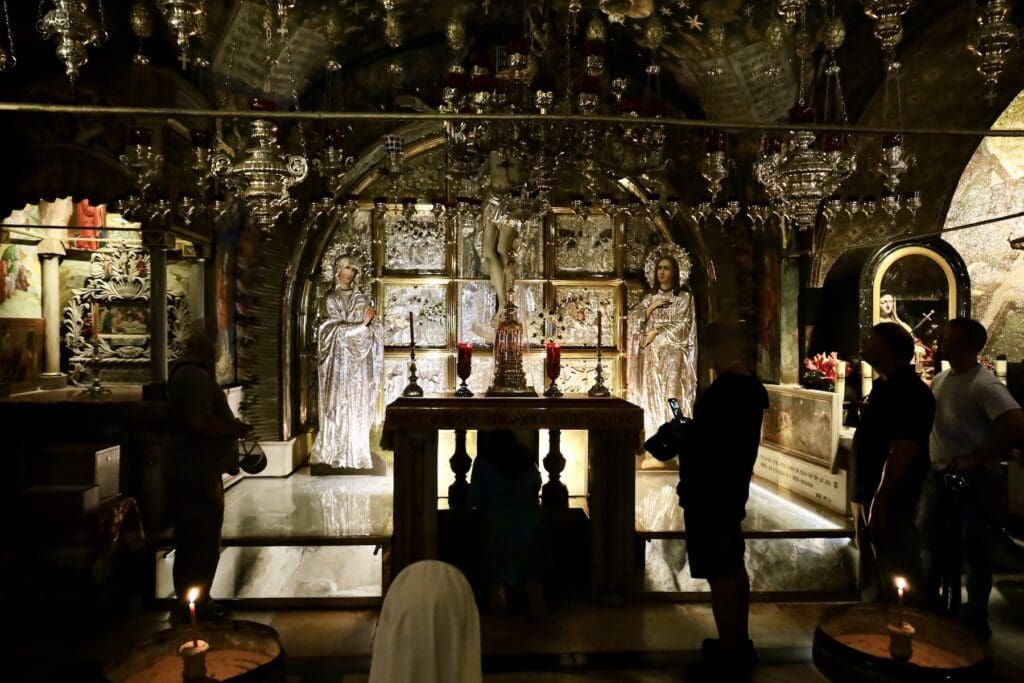
Our first stop was Calvary (Golgotha), which marks the location where many Christians believe Jesus Christ was crucified. Marked by an altar, the Rock of Calvary is the most visited location inside the Church of the Holy Sepulchre.
Next to the Rock of Calvary is a mosaic that shows the crucifixion of Jesus Christ.
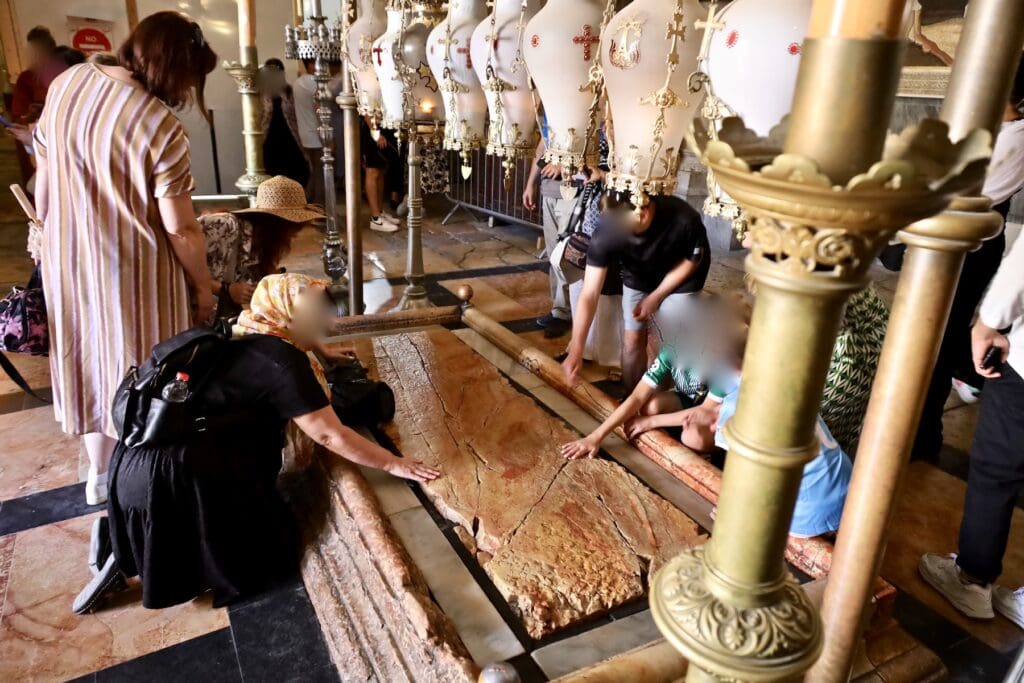
After visiting Calvary, our next stop was the Stone of Anointing. According to Christian tradition, this marks the traditional place where Jesus’ body was prepared for burial after the crucifixion. The current reddish stone slab dates from the 1810 CE reconstruction of the church following a major fire, so it is not the original 1st-century stone, but it continues a much older tradition of venerating this spot inside the Church of the Holy Sepulchre.
Visitors are able to touch the Stone of Anointing, and many people pause here to pray, leave small items, or gently place their hands or foreheads on the stone. Even though the slab itself is relatively recent, it has become a powerful devotional site where Christians remember the burial of Jesus Christ as part of their Church of the Holy Sepulchre tour.
Behind the Stone of Anointing are three mosaics that show the process of the burial of Jesus Christ: the Descent from the Cross, the Anointing, and the Burial.
The final location that we visited in the Church of the Holy Sepulchre is the location where Christians believe Jesus Christ was entombed and resurrected. There were no photos allowed inside the tomb, but I was able to take a few photos of the exterior.
The larger of the two domes at the Church of the Holy Sepulchre is located above the tomb of Jesus. The dome opens up towards the sky, and sunlight shines directly down on the tomb of Jesus.
I had to wait about 30 minutes for my turn to enter the Tomb of Jesus Christ. As stated earlier, there are no photos allowed inside the tomb, and there are ushers located outside and inside the tomb to keep the crowds of people moving.
During our tour of the Church of the Holy Sepulchre, Udi stayed near the Stone of Anointing to answer any questions. I did explore additional parts of the Church of the Holy Sepulchre, but without having the expertise of my guide, I decided not to include them in my descriptions.
Jerusalem Tours and Packages
In my opinion, the best way to see the holy sites of the Old City of Jerusalem is to take a guided tour. Below, I have linked a few tour packages. These packages offer group tours and private tours of the holy sites of the Old City of Jerusalem, including combinations like a Jerusalem and Yad Vashem tour or a Jerusalem day trip from Tel Aviv.
Please note that I am an affiliate of Viator. If you purchase a tour using one of my links, I will receive a small commission. This commission is at no additional cost to you.
Affiliate Partner of the Month – Fourthwall
Fourthwall powers our brand-new Buzzin’ Around the World Merch Shop. Pick up a tee, hoodie, or sticker. All profits will help me continue to run this site and deliver great content!
Buzzin Around the World's Merch Shop
Want to Launch Your Own Merch Line?
Scroll to the bottom of our Fourthwall page and tap “Start Your Own Store.” That’s a referral link—if you sign up, Fourthwall rewards me with store credit I can use to buy more gear (at no extra cost to you). We only recommend tools we use and love.
Earn $200 in Travel Rewards with the Capital One VentureOne Rewards Card
The Capital One VentureOne Rewards Card is one of the few rewards cards that does not charge an annual fee. Cardholders can earn 1.25 points for every dollar spent while enjoying 0% APR for 15 months.
Currently, Capital One is offering a signup bonus of 20,000 points (worth $200 in travel rewards) when the cardholder spends $500 in the first three months. If you are interested in this card, I would appreciate it if you would sign up with the link below, as I earn a referral bonus of 10,000 points. Those points are worth $100 in travel rewards and will help me continue to bring great content to Buzzin’ Around the World.
Once again, the Capital One VentureOne card is one of the few reward cards without an annual fee and is the perfect card for someone who is just starting to get into the travel points game.
Related Content
Israel
Jerusalem and Petra
Share this:
- Click to share on X (Opens in new window) X
- Click to share on Facebook (Opens in new window) Facebook
- Click to share on LinkedIn (Opens in new window) LinkedIn
- Click to share on Pinterest (Opens in new window) Pinterest
- Click to share on Tumblr (Opens in new window) Tumblr
- Click to share on WhatsApp (Opens in new window) WhatsApp
- Click to share on Reddit (Opens in new window) Reddit
- Click to print (Opens in new window) Print