Visiting Saqqara and Dahshur from Cairo: Less Crowded Alternatives to Giza
Why I Visited Saqqara and Dahshur from Cairo
After visiting the Pyramids of Giza, I wanted to see what some of Egypt’s other pyramid sites were like. Giza is famous for a reason, and I am glad I went, but it was also crowded, busy, and full of vendors and unofficial guides.
That is what made Saqqara and Dahshur from Cairo so interesting to me. These two pyramid sites are close enough to visit on the same day, but they felt completely different from Giza. Instead of dealing with large crowds, I was able to walk around more slowly, take better photos, and go inside several pyramids.
This page is not meant to say you should skip the Great Pyramid of Giza. If you are traveling to Egypt for the first time, Giza is still worth seeing. However, if you want to visit less crowded pyramids near Cairo, I thought Saqqara and Dahshur were much more enjoyable.
Quick verdict:
Saqqara and Dahshur were two of my favorite pyramid sites near Cairo. Giza is still worth visiting, but Saqqara and Dahshur were quieter, easier to photograph, and gave me a better look at how Egypt’s pyramids developed over time
Visiting Saqqara and Dahshur from Cairo: Less Crowded Alternatives to Giza - Table of Contents
- Why I Visited Saqqara and Dahshur from Cairo?
- Is the Great Pyramid of Giza Worth Visiting?
- Saqqara and Dahshur: The Best Less Crowded Pyramids Near Cairo
- Saqqara Area
- Dahshur Area
- Are Saqqara and Dahshur Worth Visiting from Cairo?
- Saqqara and Dahshur Tours and Packages
- Support Buzzin’ Around the World – Visit Our Affiliates
- Earning Points and Rewards
- Related Content
Disclaimer: Buzzin’ Around the World strives to provide accurate and up-to-date information based on our research at the time of publication. We respect all applicable laws and fair use principles. If you believe any information is incorrect or violates regulations, please contact us at buzzinaroundtheworld@gmail.com.
Affiliate Links and Reviews: We use affiliate links to generate income and may receive a commission at no additional cost to you when you use our links. We strive for honest and transparent reviews, even for products which we receive compensation.
Content Creation: Our content is based on our own travel experiences. All photos are our own unless otherwise stated. We sometimes utilize AI tools to assist with tasks like generating titles, summarizing content, and improving organization.
For more information: For more information, please click HERE to visit our private policy page. We can be reached at buzzinaroundtheworld@gmail.com.
Is the Great Pyramid of Giza Worth Visiting?
The Great Pyramid of Giza is one of the most visited tourist sights in Egypt. It is also one of the most recognizable landmarks in the world. Because of that, I do think the Great Pyramid of Giza is worth visiting, especially if you have never been before.
That said, my visit to the Giza Pyramid Complex was not my favorite pyramid experience in Egypt. The area was crowded, and I was constantly approached by vendors and “unofficial” guides offering to take me on the “grand tour.” I expected Giza to be busy, but I still found it difficult to fully enjoy the site.
In the photo below (right), I was trying to photograph the Great Sphinx of Giza, which is part of the Giza Pyramid Complex. The crowd made it difficult to get a clear photo. Even at the panoramic viewpoint on the outskirts of the Great Pyramid of Giza Complex, there were huge crowds. The photo below (left) shows the viewing area, and once again, it was difficult to get an unobstructed photo of the pyramids.
That experience is the main reason I appreciated Saqqara and Dahshur so much. They were not replacements for Giza, but they gave me a quieter and more relaxed way to experience Egypt’s pyramids.
Saqqara and Dahshur: The Best Less Crowded Pyramids Near Cairo
The best less crowded pyramids near Cairo that I visited were Saqqara and Dahshur. Both sites can be visited as a day trip from Cairo, and many tours combine them with Memphis.
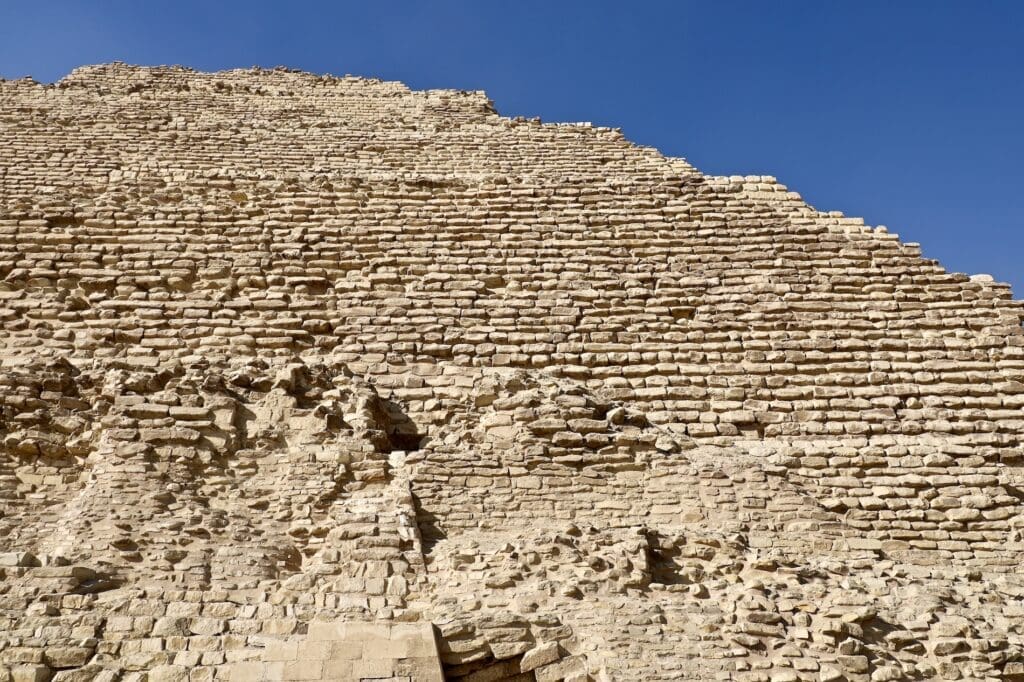
For me, Saqqara was interesting because it showed an earlier stage of pyramid building. The Step Pyramid of Djoser looks very different from the smooth-sided pyramids at Giza, and the surrounding complex helped me better understand how Egyptian pyramid design developed over time.
Dahshur was even quieter. During my visit, it felt almost empty compared with Giza. The Red Pyramid, Bent Pyramid, and Black Pyramid were all easy to photograph without crowds getting in the way.
I would plan at least a half day for Saqqara and Dahshur, though a full day is better if you want to move slowly, take photos, and go inside the pyramids. If you are planning a trip to Cairo and want more than the standard Giza experience, I think Saqqara and Dahshur from Cairo are absolutely worth considering.
Visiting Saqqara from Cairo
The first major stop on my trip was the Saqqara Area. Saqqara served as the necropolis, or cemetery, for the ancient Egyptian capital city of Memphis. Today, it is one of the most important archaeological areas in Egypt. The highlight of Saqqara is the Step Pyramid of Djoser, but the site includes much more than one pyramid. There are several pyramids, tombs, walls, courtyards, and burial structures spread across the area.
Saqqara and Dahshur are part of the broader UNESCO-listed Memphis and its Necropolis area, which includes the pyramid fields from Giza to Dahshur. That makes this area especially important if you want to see more than just the most famous pyramids.
In my opinion, Saqqara is one of the best alternatives to Giza because it offers a completely different experience. Giza is impressive because of the size and fame of the Great Pyramid. Saqqara is impressive because it shows how pyramid construction began and how burial complexes developed in ancient Egypt. If you are already visiting the Pyramids of Giza, I would still recommend adding Saqqara if you have time. It is not just a quieter version of Giza. It is a different type of pyramid site.
The Step Pyramid of Djoser
The Step Pyramid of Djoser was the first pyramid I visited at Saqqara. It is one of the most important pyramids in Egypt because it represents an early stage in pyramid construction. It was built during the Third Dynasty for King Djoser. Construction began in the 27th century BCE, and the complex is often connected with Imhotep, who served under Djoser and is traditionally credited with designing the pyramid complex.
The Step Pyramid is widely considered Egypt’s first pyramid and one of the earliest large stone monuments in the world. Seeing it in person helped me better understand how different it is from the later smooth-sided pyramids at Giza and Dahshur.
Before reaching the pyramid itself, I walked through the walled entrance into the complex. The walls were impressive and helped make the site feel more complete than I expected. At one time, the enclosure wall surrounded a large ceremonial area around the pyramid. Based on my research, the wall appears to have been symbolic and ceremonial rather than a military wall.
Just inside the entrance is a colonnade with tall columns. Many of the columns have been reconstructed or re-erected, but the entrance still gives a strong first impression. After walking through the colonnade, I arrived in the Great Courtyard, a large open space in front of the Step Pyramid of Djoser.
One question I had before visiting was whether you can go inside the Step Pyramid of Djoser. During my visit, the answer was yes, and I decided to go inside. Entrance fees in Egypt can change, so I recommend checking current prices before visiting. During my visit, entering the Step Pyramid required an additional ticket beyond the general Saqqara entrance ticket.
Pictured below (right) is the tunnel leading toward the center of the Step Pyramid of Djoser. Believe it or not, this was one of the wider and less steep pyramid tunnels I entered in Egypt. It took about three minutes to get from the entrance to the burial chamber area.
I use the word “walk” loosely. I am six foot five, so I basically had to crawl through parts of the tunnel to avoid hitting my head.
The interior of the Step Pyramid of Djoser was designed around the burial of King Djoser. When the burial chamber was discovered, Djoser’s body was not found inside. Archaeologists did find fragments of the king’s sarcophagus, along with thousands of stone vessels and jars connected to earlier kings.
I spent around 45 minutes visiting the Step Pyramid of Djoser. After retracing my steps through the tunnel, I exited the pyramid and continued through the Saqqara Complex toward the Pyramid of Unas.
Walking from the Step Pyramid to the Pyramid of Unas
I had limited time at the Saqqara Complex, so I focused on two of the best-known pyramids: the Step Pyramid of Djoser and the Pyramid of Unas. The walk between the two pyramids was one of the best parts of my visit. It took around ten minutes, and the route passed several other important structures within the Saqqara Complex. This made Saqqara feel less like a single attraction and more like a full archaeological site.
One of the highlights along the way was the Cobra Wall of Saqqara. In ancient Egypt, cobras were associated with protection. Cobras were also connected with the afterlife and the journey of the deceased.
This is one of the reasons I liked Saqqara so much. At Giza, the main draw is the size and fame of the pyramids. At Saqqara, the smaller details helped tell a bigger story about burial practices, symbolism, and pyramid development.
The Pyramid of Unas
The Pyramid of Unas is much smaller than the Great Pyramid of Giza, but historically it is extremely important. It was the first pyramid known to contain the Pyramid Texts, a collection of ancient Egyptian funerary texts carved into the walls of the burial chamber.
The Pyramid of Unas was built during the Fifth Dynasty, around the 24th century BCE, and served as the tomb of King Unas. Although it is the smallest pyramid from Egypt’s Old Kingdom, the interior makes it one of the most interesting pyramids I visited.
During my visit, there was no additional fee to enter the Pyramid of Unas. Entry was included with my ticket to the Saqqara Complex. Since ticket rules can change, I would still check current details before visiting.
Getting inside was not easy. The passage to the burial chamber was only about four feet high, and I had to literally crawl through parts of the tunnel. Of all the pyramid passages I entered, this was one of the least comfortable.
Inside the burial chamber, the walls contain some of the earliest known examples of the Pyramid Texts. These hieroglyphic funeral texts were meant to help guide the soul of the deceased king into the afterlife. As I photographed the burial chamber inside the Pyramid of Unas, it was amazing to think that the carvings on the walls were more than 4,000 years old.
I spent about thirty minutes inside the Pyramid of Unas. On my way out, I stopped and visited a few other nearby buildings, including the Tomb of Iynefert. The area around the Pyramid of Unas includes tombs belonging to important people from the reign of King Unas.
Tomb Reliefs Near the Pyramid of Unas
After visiting the Pyramid of Unas, I went into several nearby tombs. When I uploaded my photos after the trip, I had trouble matching every relief with the exact tomb. I believe some of these reliefs may have come from the Tomb of Iynefert, but I am not completely sure. Because of that, I do not want to identify them too specifically.
The first relief appears to show an offering or ritual scene with several figures.
The second relief shows animals, birds, and other figures. It looks like a scene connected to livestock, food, or offerings, which were common themes in ancient Egyptian tomb art.
The third relief shows workers carrying goods, baskets, animals, and possibly food items. These types of scenes often represented daily life, food production, and offerings for the deceased.
Even without knowing the exact interpretation of each scene, these tomb reliefs were one of the most memorable parts of Saqqara for me. It is hard to imagine that carvings like this have survived for more than 4,000 years.
I spent a few hours visiting the Saqqara Complex. By the time I left, I felt like Saqqara had given me a much better understanding of Egypt’s pyramids than Giza alone.
After leaving Saqqara, I continued to Dahshur. If Saqqara felt less crowded than Giza, Dahshur felt even quieter. During my visit to Dahshur, I saw the Red Pyramid, the Bent Pyramid, and the Black Pyramid. I also went inside the Red Pyramid, which ended up being one of the most physically difficult pyramid interiors I visited.
For travelers looking for less crowded pyramids in Egypt, Dahshur is one of the best places I visited. The site felt open, quiet, and easy to photograph. Compared with Giza, the difference was huge.
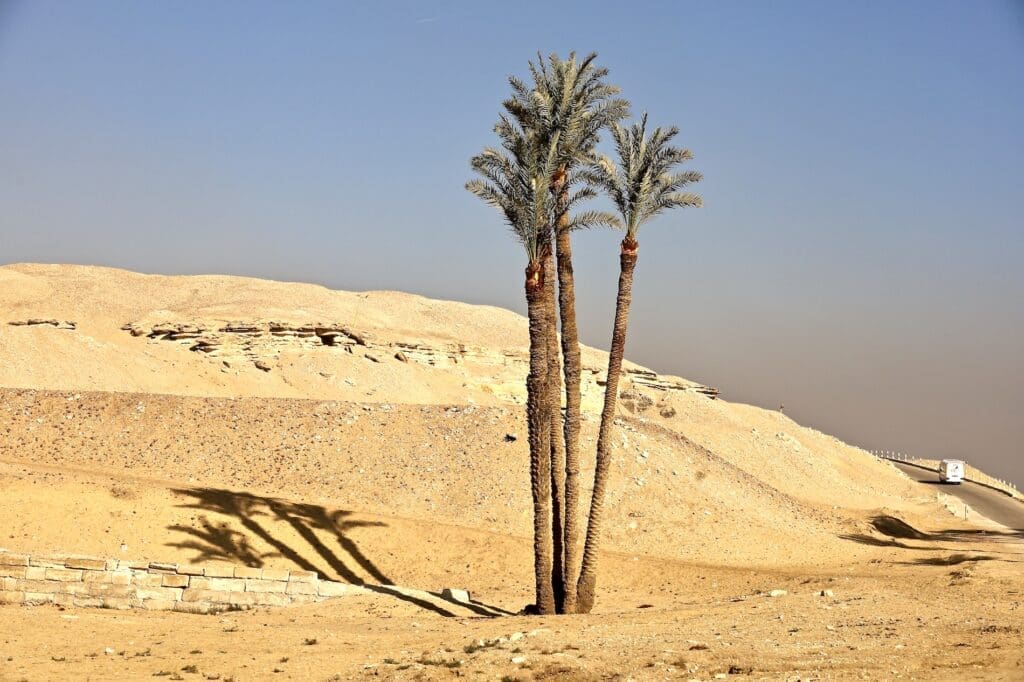
On the way to Dahshur, I stopped multiple times to photograph the palm tree forests. I have seen plenty of palm trees in my travels, but these palm forests were denser than anything I had seen before.
Entrance fees for Dahshur can change, so I recommend checking current prices before visiting. During my trip, I thought Dahshur was an excellent value for how much I enjoyed the site.
The Red Pyramid at Dahshur
The first pyramid I visited at Dahshur was the Red Pyramid. This pyramid is also sometimes called the “Perfect Pyramid” because of its smooth-sided shape. The Red Pyramid was built for King Sneferu during the Fourth Dynasty, around the 26th century BCE. It is often considered the first successful true smooth-sided pyramid, making it an important step between earlier pyramid designs and the later pyramids at Giza.
Entrance into the Red Pyramid was included with my Dahshur ticket. To reach the entrance, I had to climb a long set of steps up the side of the pyramid. Even if you decide not to go inside the Red Pyramid, I recommend climbing to the entrance area. The ledge near the entrance is a great place to photograph the pyramid itself and the surrounding desert.
The photo below (right) was taken from the viewing platform just below the entrance to the Red Pyramid.
I decided to go inside the Red Pyramid even though there was a warning that the passage was narrow and could feel claustrophobic. That warning was accurate. It took me around ten minutes to crawl down the passage and reach the chamber inside the pyramid. The hardest part was passing other visitors who were coming back up toward the entrance. I also found it difficult to breathe in the warm, stuffy air.
The Red Pyramid ended up being the only pyramid I entered at Dahshur. After crawling through its tunnel, I had no interest in entering another narrow pyramid passage that day.
As difficult as the trip down was, climbing back up to the entrance felt even harder. I believe it took me at least fifteen minutes to retrace my steps. When I finally exited the Red Pyramid, I had never been so happy to breathe fresh air.
The photo below (left) was taken near the bottom of the tunnel and looks back up toward the entrance.
Inside the Red Pyramid, there are multiple chambers. The most impressive feature was the high corbelled ceiling, which rises sharply above the chamber. It is incredible to think that ancient Egyptians were able to construct this type of interior more than 4,500 years ago.
To reach the burial chamber, I had to crawl through a small opening between massive stones. The Red Pyramid was built for King Sneferu, although his remains were not found inside.
The photo below shows the Red Pyramid from one of the photography points. You can see the entrance just left of center. Even if you do not go inside, the Red Pyramid at Dahshur is worth visiting. There were no major crowds during my visit, and I was able to get clear, unobstructed photos of the pyramid.
The Bent Pyramid of Sneferu
The second pyramid I visited at Dahshur was the Bent Pyramid of Sneferu. This pyramid gets its name from its unusual shape. The lower section rises at a steep angle, while the upper section changes to a shallower angle, giving the pyramid its bent appearance.
The Bent Pyramid is especially interesting because it shows the ancient Egyptians still working through the techniques that would later lead to the true smooth-sided pyramids at Giza. Before this period, pyramids were built in a stepped style. By the time the Bent Pyramid was constructed, builders were experimenting with the form that would later be perfected in Egypt’s most famous pyramids.
I did not go inside the Bent Pyramid. After going inside the Red Pyramid, I was done crawling through pyramid tunnels for the day. The passage into the Bent Pyramid also looked narrower than the Red Pyramid’s tunnel, which made my decision easy.
Even from the outside, the Bent Pyramid was one of the most interesting pyramids I saw in Egypt. Its shape makes it easy to understand how pyramid construction developed through trial and error.
The Black Pyramid of Amenemhat III
The final pyramid I visited at Dahshur was the Black Pyramid of Amenemhat III. This pyramid is sometimes called the Sunken Pyramid because of its ruined appearance and poor condition today. Unlike the Red Pyramid and Bent Pyramid, the Black Pyramid does not have the same dramatic appearance from a distance. I still thought it was worth seeing because it showed a completely different side of Egypt’s pyramid history.
The Black Pyramid of Amenemhat III was built much later than the pyramids of Sneferu, during the Middle Kingdom. It has not survived in the same way as the earlier stone pyramids at Dahshur, but that is part of what made it interesting to see. Seeing the Black Pyramid after the Red Pyramid and Bent Pyramid helped show how varied Egypt’s pyramids really are.
Are Saqqara and Dahshur Worth Visiting from Cairo?
In my opinion, Saqqara and Dahshur are worth visiting, especially if you are interested in Egypt’s pyramids beyond Giza. Giza has the most famous pyramids, but Saqqara and Dahshur gave me a more enjoyable overall experience. The sites were quieter, easier to photograph, and more interesting than I expected. I also liked seeing how pyramid construction changed from the Step Pyramid to the Red Pyramid and Bent Pyramid.
If you only have time for one pyramid site in Egypt, most travelers will probably choose Giza. I understand that. But if you have another half day or full day in Cairo, I would strongly consider visiting Saqqara and Dahshur from Cairo. If you are looking for less crowded pyramids in Egypt, Saqqara and Dahshur were easily two of the best places I visited near Cairo.
For me, these were not just backup options or minor side trips. They were some of the best pyramid experiences I had in Egypt.
The easiest way to visit Saqqara and Dahshur from Cairo is to take a tour or hire a private driver. The sites are spread out, and having transportation arranged makes the day much easier. Many tours also include Memphis, which pairs naturally with Saqqara and Dahshur.
For your convenience, I have linked some tour options below. Please note that I am an affiliate of Viator. If you purchase a package using one of my links, I will receive a small commission. This commission is at no additional cost to you.
Affiliate Partner of the Month – Fourthwall
Fourthwall powers our brand-new Buzzin’ Around the World Merch Shop. Pick up a tee, hoodie, or sticker. All profits will help me continue to run this site and deliver great content!
Buzzin Around the World's Merch Shop
Want to Launch Your Own Merch Line?
Scroll to the bottom of our Fourthwall page and tap “Start Your Own Store.” That’s a referral link—if you sign up, Fourthwall rewards me with store credit I can use to buy more gear (at no extra cost to you). We only recommend tools we use and love.
Earn $200 in Travel Rewards with the Capital One VentureOne Rewards Card
The Capital One VentureOne Rewards Card is one of the few rewards cards that does not charge an annual fee. Cardholders can earn 1.25 points for every dollar spent while enjoying 0% APR for 15 months.
Currently, Capital One is offering a signup bonus of 20,000 points (worth $200 in travel rewards) when the cardholder spends $500 in the first three months. If you are interested in this card, I would appreciate it if you would sign up with the link below, as I earn a referral bonus of 10,000 points. Those points are worth $100 in travel rewards and will help me continue to bring great content to Buzzin’ Around the World.
Once again, the Capital One VentureOne card is one of the few reward cards without an annual fee and is the perfect card for someone who is just starting to get into the travel points game.
Related Content
Share this:
- Share on X (Opens in new window) X
- Share on Facebook (Opens in new window) Facebook
- Share on LinkedIn (Opens in new window) LinkedIn
- Share on Pinterest (Opens in new window) Pinterest
- Share on Tumblr (Opens in new window) Tumblr
- Share on WhatsApp (Opens in new window) WhatsApp
- Share on Reddit (Opens in new window) Reddit
- Print (Opens in new window) Print